Snakes in Indiana: Native Species From Garter Snakes to Copperheads
Indiana’s snakes range from familiar striped gartersnakes to copperheads that deserve extra distance. If you have spotted a snake near your home, on a trail or beside water, the challenge is knowing what the sighting can—and cannot—tell you. This overview explains Indiana’s native snakes, useful identification clues, and sensible steps for sharing space safely.
Indiana’s native snakes at a glance
Indiana is home to many kinds of snakes, but seeing one does not automatically mean you have found a dangerous species. The Indiana Department of Natural Resources, Division of State Parks describes the state as having 32 native snake species of which only four are venomous. That distinction matters: most native snakes are nonvenomous, while a small number require extra caution.
The Indiana Department of Natural Resources, Division of State Parks also describes more than 30 species in Indiana. The range of species means there is no single appearance, habitat or size that represents every Indiana snake. Some are more likely to be noticed around yards, others near water or natural areas, and many may go unseen even where they occur.
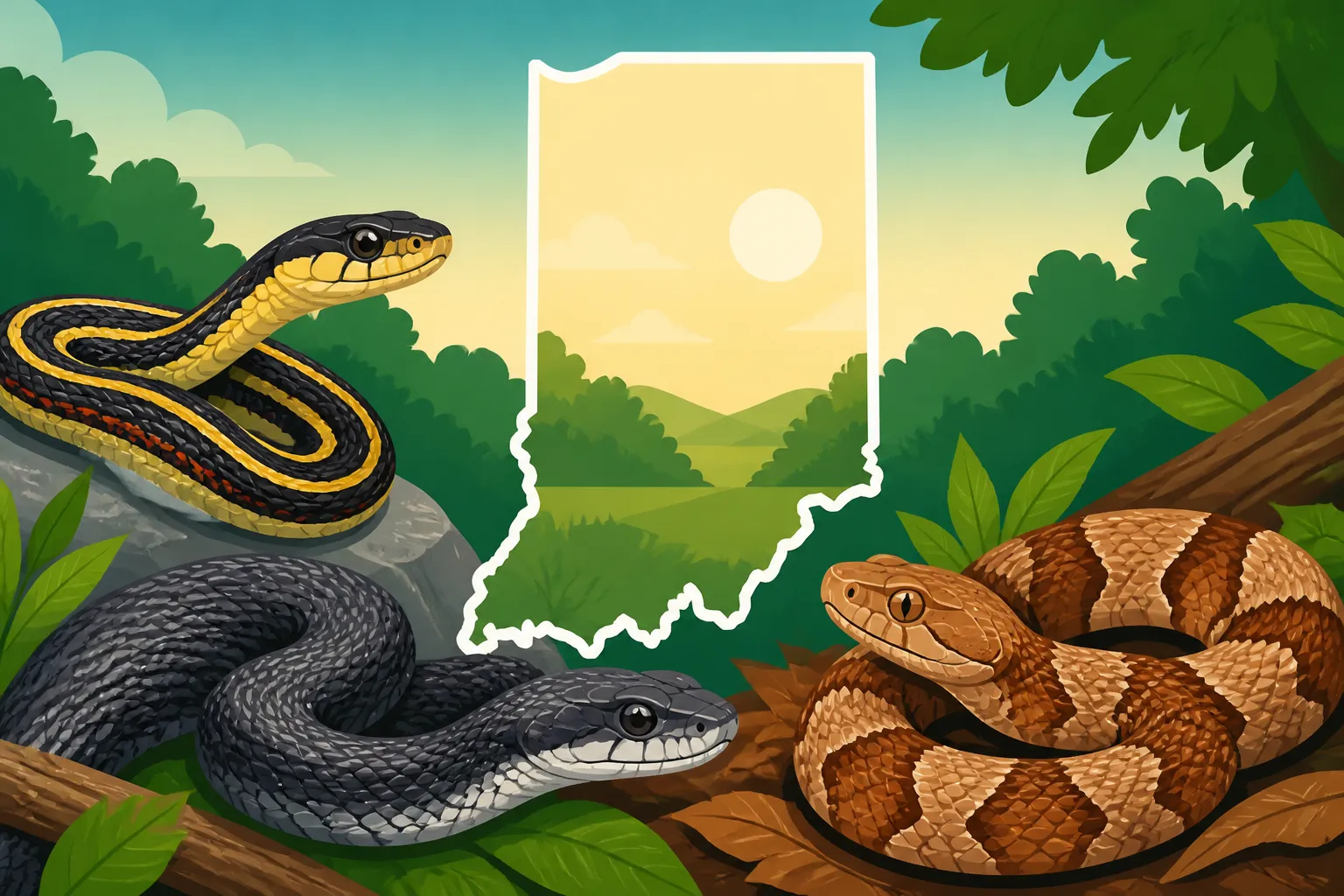
For everyday sightings, two useful starting points are gartersnakes and watersnakes. Gartersnakes are commonly marked by three light stripes. Watersnakes often have dark crossbands and are frequently found near water. Those patterns can help narrow down what you are seeing, but they are not a guarantee of identity. Color, pattern, lighting, distance and the snake’s posture can all make a quick impression misleading.
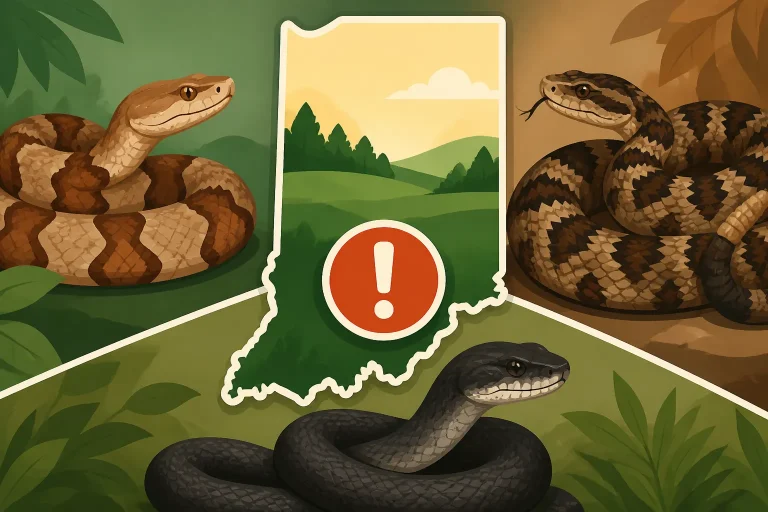
Copperheads are the venomous snake most often singled out in Indiana. They have a coppery-colored head and reddish-brown hourglass bands. The Northern copperhead is Indiana’s most common venomous snake, according to the Indiana Department of Natural Resources, Division of State Parks. The agency says the species is somewhat common in southern and west-central Indiana. A sighting in a different part of the state should not be treated as proof of a copperhead, but location alone cannot identify an animal either.
A quick overview can help you decide what kind of question you have: Is the snake near people or pets? Is it in a place where it can be left undisturbed? Do you need a professional opinion? If your identification is uncertain, do not approach or handle the snake. Give it room, keep others back and seek help from an appropriate professional or wildlife agency if the situation calls for it.
| What you notice | Useful first clue | What the clue can tell you |
|---|---|---|
| Three light stripes | Often associated with gartersnakes | A helpful feature to observe from a distance, not a complete identification |
| Dark crossbands and water nearby | Often associated with watersnakes | A reason to consider a watersnake, but not proof of species |
| Coppery-colored head and reddish-brown hourglass bands | Features associated with copperheads | A reason to keep well away and avoid handling |
| Unclear pattern, poor light or a distant view | Identification is uncertain | Keep your distance rather than guessing |
For a broad introduction to the state’s snakes, see Common Garter Snakes, Watersnakes and Other Everyday Indiana Snakes. If you want help comparing an unknown animal with likely look-alikes, What Snake Is This? Identifying Snakes Around Indiana Homes covers the value and limits of visual clues.
Common snakes you may encounter
A snake in a yard or along a path is not necessarily an unusual sight. Gartersnakes and watersnakes are among the kinds of nonvenomous snakes people may encounter in Indiana. Their recognizable patterns can offer a starting point, but a safe decision does not depend on getting a perfect identification.
Gartersnakes are often associated with three light stripes along the body. From a safe distance, look for the general arrangement of the stripes rather than trying to count or inspect markings at close range. The body may be partly hidden by grass, leaves or other cover, and the snake may be moving. A partial view can leave out the very feature you need.
Watersnakes are often associated with dark crossbands and are commonly found near water. A snake swimming or resting at the edge of a pond, marsh or other waterway may prompt questions about whether it is a watersnake. Habitat can be a clue, but it is not a substitute for identification. Other animals can use the same places, and a water-adjacent sighting does not by itself tell you which species is present.
The setting can shape what you notice. A snake crossing a driveway may be visible only briefly; one tucked beside a foundation may be mostly concealed. Near water, the animal may be difficult to see clearly through reflections or vegetation. Outdoors, the safest approach is to observe from where you already are, avoid blocking its path, and let it move away.
A snake’s color may also be misleading. A pattern that seems obvious from a photograph can look different in shade, bright sunlight or a low-quality image. A snake that is partly covered may appear to have bands or stripes that are not actually visible in full. Even people familiar with common patterns can be uncertain when they see only a quick glimpse.
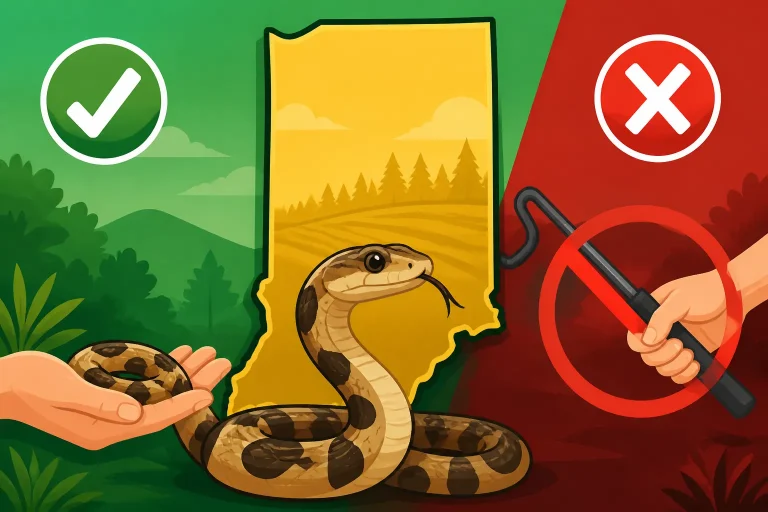
Do not try to capture a snake to confirm what it is. Handling creates a risk of a bite and may injure the animal. It also removes the benefit of distance, which is the simplest way to keep a routine encounter from becoming a close one. If you cannot confidently identify the snake, treat it as unknown and leave it alone.
For pattern comparisons, Garter Snake or Look-Alike? Telling Them Apart in Indianapolis focuses on a familiar identification question, while Identifying the Snakes in Indiana Lakes, Ponds and Marshes is relevant when a sighting happens near water. For a snake in or around a building, Found a Snake in Your Indiana Yard or House? Start Here offers a situation-focused next step.
Copperheads and the question of venom
Copperheads deserve a different level of caution from a snake you can confidently identify as a harmless species. The useful visual clues provided by the Indiana Department of Natural Resources, Division of State Parks are a coppery-colored head and reddish-brown hourglass bands. The description can help you understand what to look for, but it is not a license to approach an animal for a closer view.
The agency says, Only copperheads can be considered somewhat common. It describes them as occurring in southern and west-central Indiana. That regional information helps put sightings in context: those ranges do not point to Indianapolis as a typical location for them. Still, a location is only background information. It cannot safely confirm or rule out what a particular snake is.
A common source of confusion is assuming that a snake near water must be a copperhead or that a banded snake must be one. Watersnakes can have dark crossbands, and copperheads have reddish-brown hourglass bands. The word “banded” alone is not enough to sort them out. Nor is a snake’s apparent size, color or location enough to declare it safe.
If the snake is distant, partly hidden or moving through poor light, the responsible choice is not to test your identification skills by getting closer. If it is near a doorway, play area or other place where people need to pass, keep people and pets away from the area and seek advice from a qualified professional or wildlife agency. Do not attempt to pin, pick up, corner or kill it.
The same caution applies to photographs. A photo can sometimes show useful markings, but it can also omit the head, distort color or capture only a small portion of the snake. Never move closer just to improve the picture. A distant image is preferable to a risky close-up, and no photograph is worth handling an unknown snake.
If you are comparing an animal with possible copperhead look-alikes, Copperhead Bands vs Watersnake Bands: Reading the Hourglass and Snakes That Look Like Copperheads in Indiana: Milk Snakes and More address why pattern comparisons can be tricky. Venomous Snakes in Indiana: How to Recognize Each Species is a more focused resource for the state’s venomous snakes. Use identification information to support caution, not to justify approaching an uncertain animal.
Reading a sighting without overrelying on one clue
Good identification is a process of gathering clues while keeping a safe distance. No single clue should carry the whole decision. Instead of asking only, “What color is it?” consider what you can actually see: the body pattern, the shape and color of visible markings, the location, how much of the animal is exposed, and whether the view is clear.
Start with what is visible
Describe what you can see rather than deciding what you think the snake must be. For example, note whether the body appears to have stripes or crossbands, whether the head is visible, and whether the snake is near water. A description can remain useful even if it does not lead to a confident species identification.
Pay attention to what you cannot see, too. A snake that is partly under a deck, in thick vegetation or behind stored items may show only a small section of its body. That limited view should lower confidence, not encourage you to reach into the hiding place. If the animal is moving away, let it go rather than trying to follow it.
Treat habitat as context, not proof
A snake seen beside water could fit the general setting associated with watersnakes, but habitat does not confirm species. The same principle applies to a sighting in a yard, garden, shed or wooded area. Many animals can use overlapping spaces, and a familiar location does not guarantee a familiar snake.
Location within Indiana can also be context, not a final answer. The fact that copperheads are described as somewhat common in southern and west-central Indiana does not make every snake there a copperhead. Nor does a sighting outside those regions make close inspection safe. Relying on geography alone can turn uncertainty into a confident but mistaken guess.
Be careful with photos and memory
People often have only a few seconds to observe a snake. Afterward, memory can emphasize the most striking feature and lose details that matter. A photograph may help preserve an image, but it is useful only if taken without approaching or disturbing the snake.
If you take a picture from a safe distance, keep the image honest: do not put your hands or an object beside the animal for scale, and do not try to move the snake into a better position. If the photo does not clearly show enough detail, accept that the identification may remain uncertain.
Know when to stop trying
Identification has a practical limit. If the snake is close, hidden, in a busy area or not clearly visible, distance is a better tool than further examination. When unsure, keep away and contact a professional or wildlife agency for guidance. You do not need to name the species before taking a safe next step.
This approach is especially useful when different snakes share similar colors or patterns. Pit Viper or Not? Heat Pits, Eye Shape and Other Indiana Clues discusses identification features, while Photographing a Snake for an ID Without Getting Close in Indiana is useful if you are trying to document a sighting from a safe distance.
What to do when you find a snake
The first decision is not “Should I move it?” but “Can I leave it undisturbed?” If the snake is outside and not creating an immediate problem, keeping your distance and allowing it to move on is often the simplest response. Do not surround it or make repeated attempts to get a better look.
When the snake is in a place people or pets need to use, create space between the animal and others. Keep children and pets away, and avoid walking close to the snake. If practical, use a different route while it remains there. Do not ask someone to handle it unless they are qualified to deal with the situation.
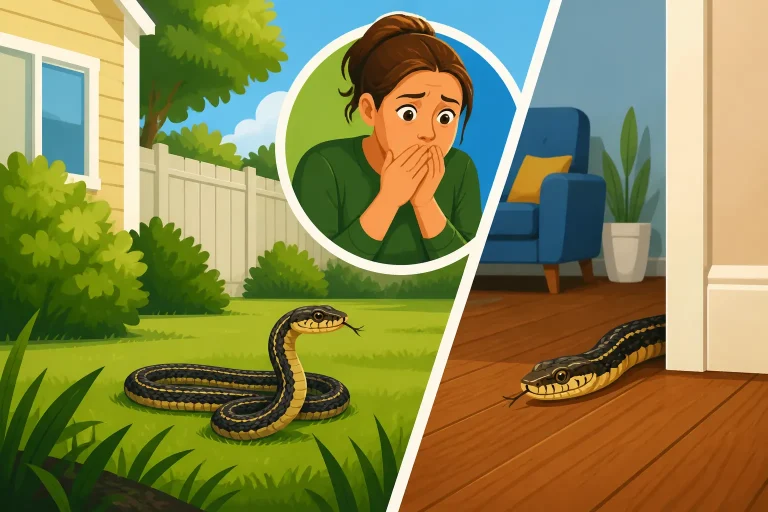
A snake inside a house, garage or shed can make the situation harder because people may need to move through the space. Keep people out of the affected area and do not try to corner the animal. If you can safely close a door to keep the area separate without approaching the snake, that may help limit access. Otherwise, back away and get guidance from a qualified professional.
Avoid trying to catch, trap or relocate the animal yourself. A snake can react defensively if approached or restrained, and a mistaken identification increases the risk. If you need help with removal, find a professional who handles wildlife and ask about the service and process before work begins. Hiring a Wildlife Control Operator for a Snake in Indiana explains what to consider when seeking assistance.
A useful sequence is:
- Stop and give the snake room.
- Keep children and pets away.
- Do not touch, corner or try to kill it.
- If it is in a building or a place that cannot be avoided, keep people out of the area and seek professional guidance.
- If you are uncertain about the species, treat it as unknown rather than relying on a quick guess.
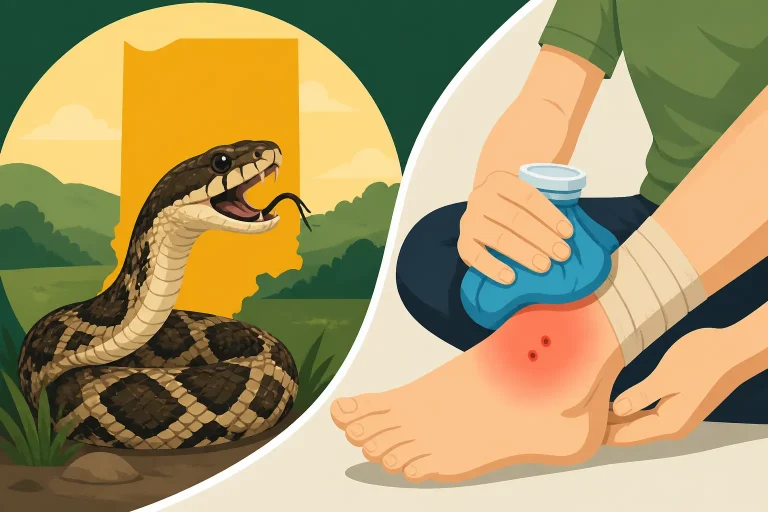
If someone is bitten, seek emergency help. Call 911 or Poison Help at 1-800-222-1222. Do not try to catch the snake; a photograph from a safe distance may be useful only if it can be taken without approaching it. Snakebite in Indiana: The First Steps While Help Is on the Way covers the immediate response.
Sharing space with snakes around homes and outdoors
A snake sighting can be unsettling, especially near a home, but not every sighting means a snake has moved indoors or established itself in a particular place. A single observation is just that: an animal was visible at a particular time. Avoid assuming that it is dangerous, that more are present, or that it will return.
If you see a snake in the yard, note the location from a safe distance and consider whether anyone needs to use that area. Keep people and pets away while it is present. If the snake is moving off, do not chase it. If it disappears into vegetation or a gap, do not reach in after it. A hidden animal is harder to identify and easier to disturb.
For a snake near a house, distinguish between seeing one outdoors and finding one inside. Outdoor sightings can be handled by giving the animal room and adjusting where people walk until it moves away. A snake inside a room or outbuilding may require professional help because the animal’s location can be unclear and household members may need access to the space.
If you are concerned about repeated sightings, take notes from a distance. Record where the snake was seen and what features were visible. A note that says “striped snake near the garden” is more honest and useful than a species name based on a fleeting view. Share observations with a professional or wildlife agency if seeking guidance.
On trails and in natural areas, watch where you step and avoid reaching under logs, rocks or vegetation where you cannot see. If you encounter a snake, stop, give it space and allow it to move away. Do not try to pick it up for a photograph or move it off the trail by hand. If You Meet a Snake on an Indiana Trail, Give It Room provides more trail-focused advice.
Families can set a simple rule: look from a distance, tell an adult, and never touch a snake. That rule works whether the animal appears familiar or not. Children may be drawn to patterns or want a closer view, so explain that distance is part of being a good observer. Teaching Kids What to Do When They Find a Snake in Indiana offers additional ideas for discussing safe behavior.
Common misconceptions and sensible expectations
One misconception is that every snake with bands is venomous. Pattern alone is not enough to identify a snake, and the appearance of bands varies. Watersnakes are often described as having dark crossbands, while copperheads have reddish-brown hourglass bands. If the difference is not clear from where you are standing, do not close the distance to settle the question.
Another misconception is that the place where a snake is found confirms its identity. A snake near water may prompt a guess about watersnakes, and a sighting in the southern part of Indiana may prompt a guess about copperheads. These details can provide context, but neither one identifies an individual animal. Look at the limits of the evidence, not just the clue that seems to fit.
It is also easy to assume that a snake in a yard is seeking out people. A sighting does not reveal why the snake is there or what it will do next. Avoid approaching it to test its behavior. Give it room and choose a safe route around it.
A further mistake is treating a clear-looking photo as a certain identification. Images can change color and scale, and the most important feature may be hidden by angle or shadow. If a picture leaves room for doubt, let the uncertainty remain. The practical response—keep away and seek help if necessary—does not require certainty.
Finally, do not assume that a snake is safe to handle because it looks small, calm or familiar. A snake that is difficult to identify should not be touched. The safest distinction for a member of the public is often not between one species and another, but between an animal that can be left alone and a situation that needs qualified help.
For additional context on how different species are distributed, Where Venomous Snakes Live in Indiana, Region by Region can help frame questions about location. For a broader look at species and conservation concerns, Protected Snakes in Indiana, From Endangered to Special Concern is a related resource. Neither location nor status information replaces caution around an unidentified snake.
Frequently Asked Questions
How many native snake species are in Indiana?
Indiana has a varied native snake community, and only a small portion of its native species are venomous. The state figure is useful context, but it cannot identify an individual snake you see.
Which Indiana snakes are most likely to be noticed around people?
Gartersnakes and watersnakes are among the common nonvenomous snakes people may encounter. Gartersnakes are often recognized by light stripes, while watersnakes are often associated with dark crossbands and water. Treat these as clues, not guarantees.
Are copperheads common throughout Indiana?
No. The Indiana Department of Natural Resources describes copperheads as somewhat common in southern and west-central Indiana. That regional pattern makes Indianapolis an atypical place to expect one, but it cannot confirm or rule out a snake based on location alone.
What should I do if I cannot identify a snake?
Keep your distance, keep other people and pets away, and do not handle it. If it is in a place that needs attention, contact a qualified professional or wildlife agency for guidance.
Sources
- Indiana Department of Natural Resources, Division of State Parks — Fish and Wildlife: Snakes (checked November 20, 2026)
- Indiana Department of Natural Resources, Division of State Parks — Fish and Wildlife: Amphibians and Reptiles FAQs (checked November 20, 2026)
- Indiana Department of Natural Resources, Division of State Parks (checked November 20, 2026)
Disclaimer
This article is for general informational purposes only and does not constitute professional advice. Laws, prices and regulations vary by location and change over time. Consult a qualified professional for guidance on your specific situation. Indiana Critter Guide is not a government agency or pest control company and is not affiliated with any government agency.