What Snake Is This? Identifying Snakes Around Indiana Homes
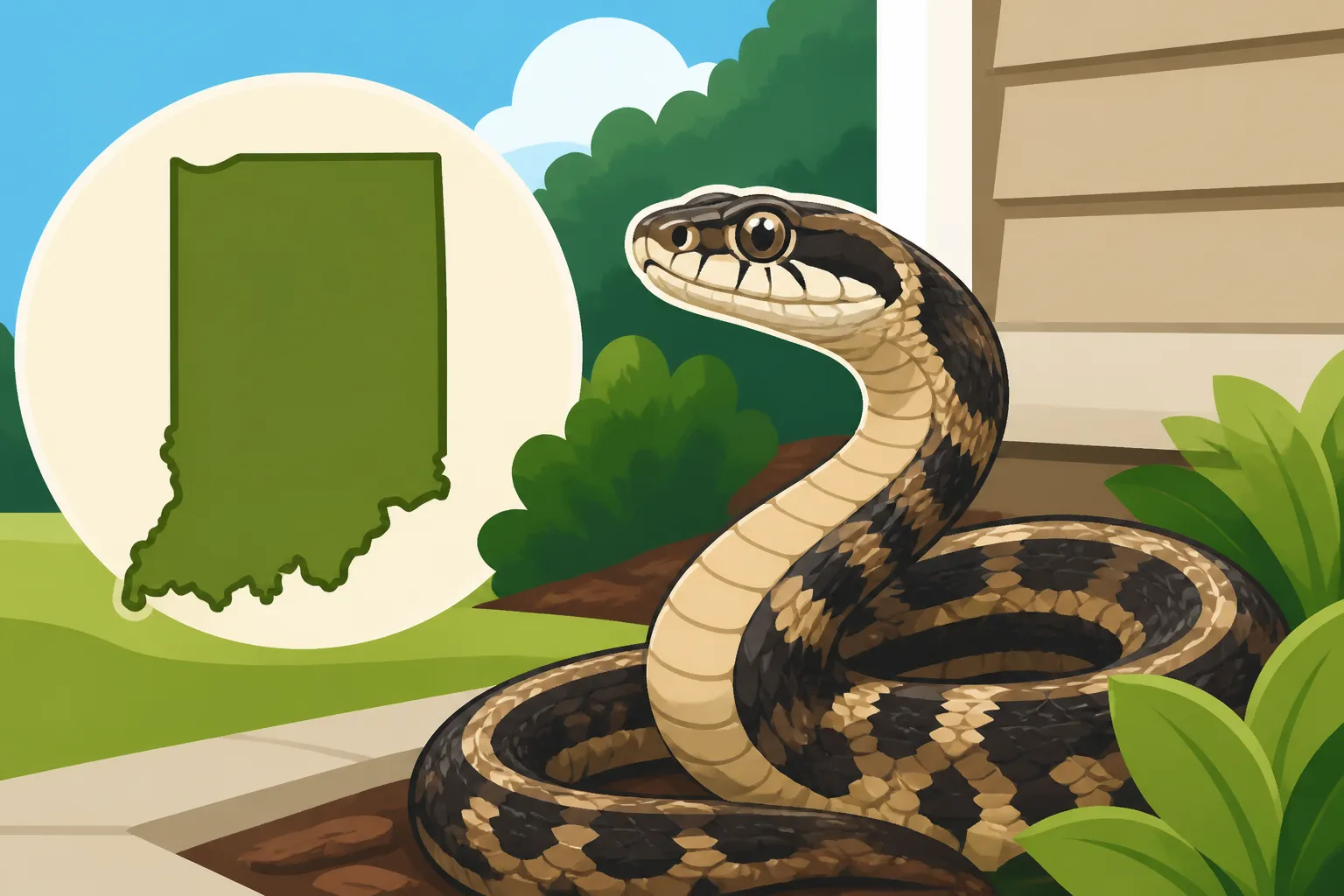
A snake near a house can be hard to identify from a quick glance, especially when patterns resemble one another or the animal is partly hidden. This guide explains which clues are useful around Indiana homes, how to compare them without getting close, and what to do when an identification is uncertain. The safest starting point is to observe from a distance rather than trying to handle or move the snake.
First, give the snake space
If you find a snake in a yard, garage, basement, or near a doorway, resist the urge to approach it for a better look. Stay back and keep children and pets away from the area. A snake’s color or apparent calmness does not establish what species it is, and a close encounter is not necessary to begin an identification.
The Indiana Department of Natural Resources, Division of State Parks advises: Don’t handle a snake you can’t confidently identify. If you are unsure, keep your distance and contact a wildlife agency or qualified professional for guidance. If the snake is inside, avoid reaching into places where you cannot see clearly, such as behind stored items or beneath furniture.
A useful first response is to note where the snake is and whether it is moving into an area people use. You do not need to follow it or corner it. If you can watch without approaching, observe enough to describe its general appearance and location. If you cannot do that safely, stop trying to identify it yourself.
For a snake that has entered the home, close off access to the room only if you can do so without getting close to the animal. Keep people and pets out, and seek appropriate help. Found a Snake in Your Indiana Yard or House? Start Here covers practical next steps for a snake found at home, while Snake Loose Inside the House: Calm Steps for Indiana Homeowners focuses on an animal indoors.
Do not try to catch, pin, pick up, or kill an unidentified snake. Those actions bring you closer and can make a situation more difficult. If the snake moves away, let it go. You do not need to determine its species before deciding to leave it alone.
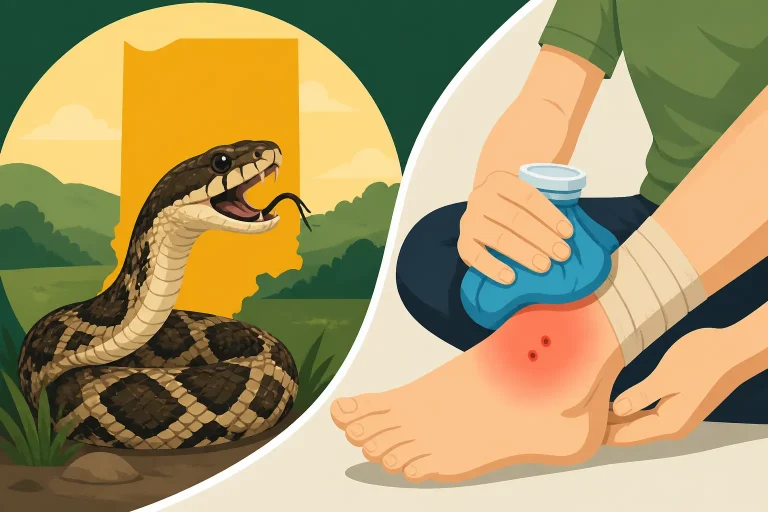
If someone is bitten, treat it as a medical emergency and call 911 or Poison Help at 1-800-222-1222. Do not delay getting help while trying to identify or capture the snake.
How to compare a snake’s identification clues
A reliable identification is built from several observations, not a single feature. Indiana DNR’s snake profiles describe identification clues such as size, coloration and patterns, body or head shape, and habitat; compare those features with the species descriptions and illustrations. A close match across several clues is more useful than a guess based only on color.
Start with what you can see without moving closer. Ask yourself:
- Is the snake’s body mostly one color, or does it have stripes, bands, blotches, or another visible pattern?
- Does the pattern repeat along the body, and is it clear enough to describe?
- What does the head look like from your viewing angle?
- Does the snake appear slender or thick-bodied?
- Is the snake near water, in a garden, beside a foundation, or in an outbuilding?
- Which parts of the animal are hidden, and which are visible?
These questions help organize what you noticed. They do not make any one feature decisive. A head that looks broad in a photograph might be distorted by the angle, while poor lighting can change how a color appears. A snake may also be partly covered, making its body shape or pattern difficult to judge.
Give more weight to a combination of clues
A single mark can be misleading. Two snakes may have similar colors, while the same species can look different depending on lighting, posture, or how much of its body is visible. Use the overall pattern, shape, size, and setting together. Then compare those observations with a species profile rather than matching the snake to a single image.
Habitat is a supporting clue, not proof. For instance, a snake seen near water may make a watersnake profile worth comparing, but location alone cannot confirm the species. Likewise, finding a snake around a home does not by itself tell you whether it is venomous or nonvenomous.
If the profile does not fit clearly, do not force a match. A tentative identification is still tentative, even when one or two features seem familiar. The sensible conclusion may be “unknown snake.” What Snake Is This? Identifying Snakes Around Indiana Homes is about using the features that are visible to narrow down possibilities, not taking risks to obtain a perfect view.
Treat photographs as records, not a reason to approach
A photograph can preserve details that are easy to forget, but getting it should never require moving closer, blocking the snake’s path, or touching it. If you can take a picture from a safe distance, try to include the visible body pattern and the setting. Avoid trying to make the snake turn, stretch out, or pose.
A distant or partial photo may not be enough for a firm identification. That is not a failure: an unclear image is a reason to ask for help, not to take a closer one. When describing the snake, say which features you could see and which you could not. Photographing a Snake for an ID Without Getting Close in Indiana explains how to make a useful record while keeping distance.
Snakes you may encounter around Indiana homes
The snakes most likely to come up in an identification question are not all equally likely to be found in the same setting. Some are associated with water, while others may be noticed in a yard or around a building. Use the descriptions below as starting points for comparison, not as a substitute for checking the full pattern and other visible features.
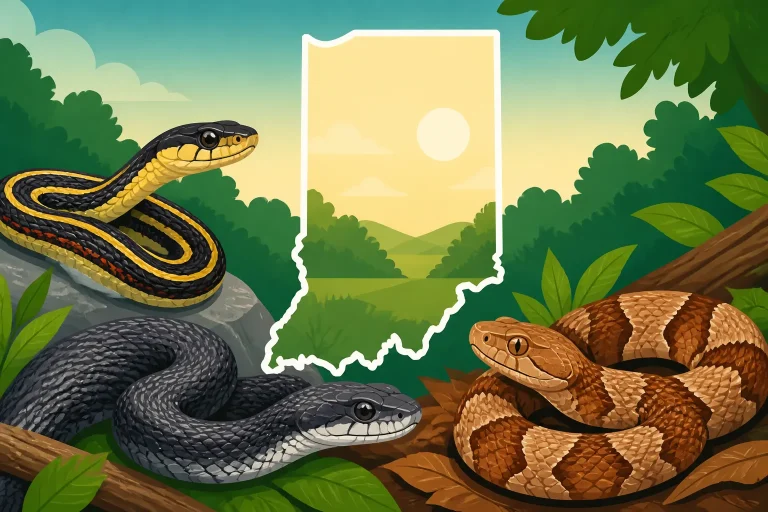
Indiana’s common nonvenomous snakes include gartersnakes and watersnakes. The Indiana Department of Natural Resources, Division of State Parks describes gartersnakes as usually marked by three light stripes, and watersnakes as having dark crossbands and often being found near water. Those patterns and settings can help direct your comparison, but neither a stripe nor proximity to water is conclusive on its own.
| Snake or group | Clues to compare | What the clue can and cannot tell you |
|---|---|---|
| Gartersnake | Usually marked by three light stripes | Stripes are a useful starting clue, but compare the full appearance with a species profile. |
| Watersnake | Dark crossbands; often found near water | Water-side habitat and bands may support a comparison, but neither confirms the species alone. |
| Eastern milk snake | Can be mistaken for a Northern copperhead | A copperhead-like appearance in a photograph does not settle the identification. |
| Fox snake | Can be misidentified as a Massasauga rattlesnake | Compare the full visible pattern and other clues rather than relying on a quick resemblance. |
| Copperhead | Coppery-colored head and reddish-brown hourglass bands | These markings are relevant clues, but do not approach a snake to inspect them. |
Gartersnakes are often a natural first possibility when a snake with visible stripes appears around a home. Still, do not treat “striped” as a complete identification. Observe the stripes from a distance, note how much of the body is visible, and compare the overall appearance with Indiana DNR’s profiles. If the snake is partly obscured or the pattern is hard to see, record that uncertainty.
Watersnakes are another group worth considering, especially when the animal is near water. The dark crossbands described by the Indiana Department of Natural Resources, Division of State Parks are a clue to compare, not a reason to handle the snake or assume its identity. A snake may be away from the place you expected to find it, and habitat alone cannot confirm which species you are seeing.
The eastern milk snake is a useful reminder that resemblance can confuse an identification. The Indiana Department of Natural Resources, Division of State Parks describes the eastern milk snake as harmless and often mistaken for the Northern copperhead. If a snake’s appearance makes you think “copperhead,” do not make a closer inspection to resolve the question. Keep your distance and compare a safe photograph or description with a trusted profile.
The fox snake is another example of why a quick visual match can go wrong. The Indiana Department of Natural Resources, Division of State Parks says the fox snake is easily misidentified as a venomous Massasauga rattlesnake. That resemblance is a reason to avoid confident guesses based on a single feature. If you cannot distinguish the snake confidently from a safe distance, treat the identification as unresolved and ask a qualified professional or wildlife agency.
For more background on the kinds of snakes found in the state, see Snakes in Indiana: Native Species From Garter Snakes to Copperheads. If the snake is near a lake, pond, or marsh, Identifying the Snakes in Indiana Lakes, Ponds and Marshes offers a more specific comparison for that setting.
Copperhead clues and look-alikes
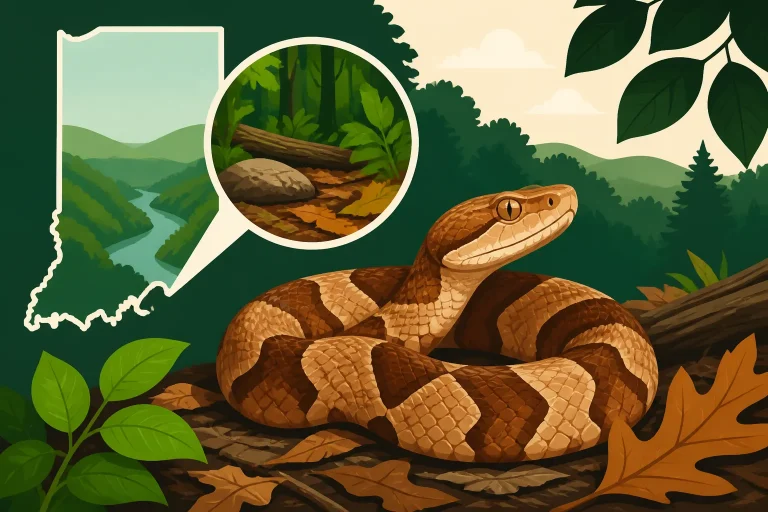
Copperheads deserve careful attention because they are the Indiana venomous snakes the facts identify as somewhat common. The Indiana Department of Natural Resources, Division of State Parks says: Only copperheads can be considered somewhat common. The same source places them in southern and west-central Indiana, so those ranges do not point to Indianapolis as a typical location for them.
That regional information can help put a sighting into context, but it is not a stand-alone identification. A snake’s location cannot prove it is or is not a copperhead. If a snake is in an area where copperheads occur, that does not confirm the species; if it is outside that area, that still does not make an uncertain snake safe to approach. Keep the focus on distance and a careful comparison of visible features.
Indiana DNR describes a copperhead’s markings as an hour-glass pattern of reddish brown bands on its body. The agency also identifies a coppery-colored head and reddish-brown hourglass bands as clues. These are useful details to look for in a photo taken from a safe distance, but do not attempt to get a better view of the head or body by approaching.
A major source of confusion is that other snakes can resemble copperheads. The eastern milk snake is one example, as noted above. A photograph can make a pattern look different from what it does in person, and shadows or partial views can hide details. When the identification matters for a safety decision, “looks a bit like a copperhead” should lead to caution, not a closer inspection.
Crossbands can also lead to mistakes. The word “banded” alone does not settle whether the snake is a copperhead, a watersnake, or something else. Compare the shape and arrangement of the bands, the rest of the body pattern, and any other visible clues together. Copperhead Bands vs Watersnake Bands: Reading the Hourglass takes a closer look at that particular comparison, and Snakes That Look Like Copperheads in Indiana: Milk Snakes and More addresses common look-alikes.
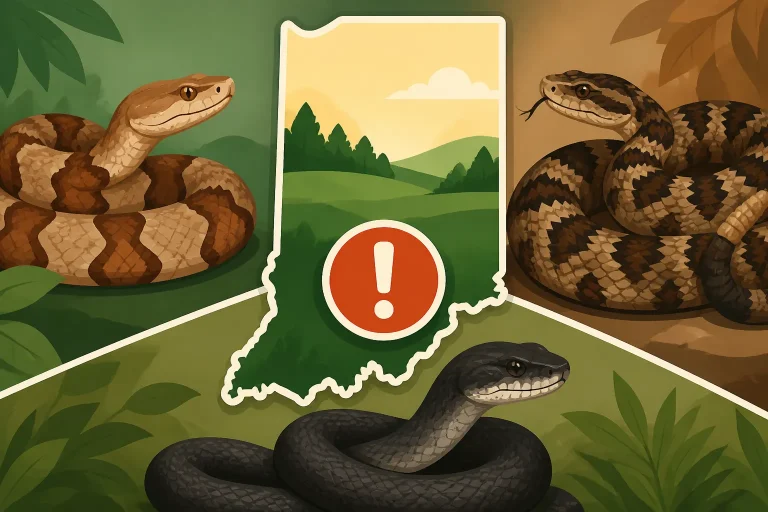
Indiana DNR lists four venomous species, but says copperheads are the only ones somewhat common, in southern and west-central Indiana. That context is helpful, but it does not turn a visual guess into a confirmed identification. Venomous Snakes in Indiana: How to Recognize Each Species covers the venomous species and the clues used to recognize them. If the snake in front of you does not match a profile clearly, avoid handling it and seek help rather than deciding based on what seems most likely.
Why a Massasauga look-alike can be hard to sort out
The Massasauga appears in Indiana identification questions because the fox snake can be mistaken for it. The important practical point is not to decide from a distant impression that a snake is definitely one or the other. The fox snake’s resemblance to a venomous Massasauga rattlesnake means a quick visual judgment may not be dependable.
If the snake is partly hidden, moving, or too far away to see its pattern clearly, do not fill in the missing details from memory. Write down what you actually observed: the visible colors, any pattern, the apparent shape, and where the snake was. Make clear when a feature was obscured or difficult to see. That description can help someone assess the sighting without requiring you to get closer.
The Massasauga is one of the venomous species included in Indiana DNR’s list. Its possible presence in an identification question does not mean that every fox snake or patterned snake should be treated as a Massasauga. It means that uncertainty deserves respect. If you cannot confidently distinguish the animal, keep your distance and contact a wildlife agency or qualified professional.
Avoid using a single photo from an online search as a final answer. Images can show a snake from a different angle, in different lighting, or with details not visible in your own sighting. A meaningful comparison looks at more than one feature and acknowledges what is missing. Rattlesnakes in Indiana: The Timber Rattlesnake and the Massasauga provides more information about Indiana rattlesnakes, while Fox Snakes and the Massasauga Mix-Up in Northern Indiana focuses on the specific confusion.
This kind of caution is not the same as assuming every snake is dangerous. It is a practical way to avoid an unnecessary close encounter when the identification is not secure. You can leave a snake undisturbed and still make a careful record of where it was and what you could see.
A safe process for checking an uncertain identification
Use a consistent process so that excitement or worry does not push you into taking a risk. The aim is to collect the clues that are already visible, compare them with reliable profiles, and stop when a safe identification is not possible.
- Stay back. Keep people and pets away from the snake. Do not approach to inspect its head, pattern, or body shape.
- Note the setting. Record whether it was in a yard, near water, beside a building, or indoors. Treat location as supporting information, not proof.
- Describe the visible pattern. Note stripes, crossbands, hourglass-shaped markings, or other visible patterns without trying to make the snake move.
- Record the limits of your view. Mention if the snake was partly covered, if lighting was poor, or if the pattern was not clear.
- Compare several clues. Use size, coloration and patterns, body or head shape, and habitat together, as described in Indiana DNR’s profiles.
- Stop at uncertainty. If the descriptions do not match confidently, keep your distance and ask an appropriate professional or wildlife agency for guidance.
If a photograph is possible without approaching, use it as supporting information. Do not try to photograph the snake from a low angle, block its route, or follow it if it moves. A picture that shows only a small part of the body may not be useful for species identification, and a blurry image should not be treated as confirmation.
A written description can still be useful when no photograph is safe or possible. Describe what you saw rather than naming a species you are unsure about. For example, it is more helpful to say “dark bands along the visible body near a pond” than to present a guess as fact. If you noticed a possible stripe or hourglass pattern, say whether it was clear or only an impression.
If you ask for identification help, use an appropriate wildlife agency or qualified professional and follow their instructions. Do not transport the snake or bring it to someone for identification. The animal can be assessed from a safe record when the available details are sufficient; if they are not, the honest answer may remain uncertain.
Some sightings do not need a species name to resolve the immediate problem. If the snake has left the area, there may be no reason to pursue it. If it remains inside or in a place where people must pass, keep people away and seek appropriate help. Can You Move a Snake Yourself in Indiana, or Who Removes It? discusses options when the question is removal rather than identification.
When the snake is in a house, garage, or yard
A snake’s location changes what is practical, but it does not change the basic identification method. Whether the animal is beside a foundation or inside a room, avoid touching it and do not take chances to improve your view. First decide how to keep people and pets away from the immediate area; species identification can come later.
In the yard
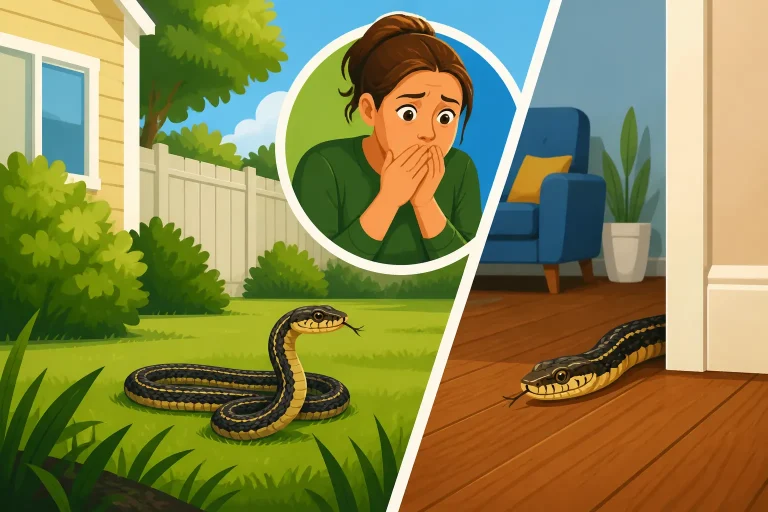
If a snake is outside and not blocking a necessary path, leave it undisturbed and give it room. Observe only from a safe distance. Do not chase it into shrubs, piles of stored material, or other places where you would lose sight of it. If it leaves, there is no need to follow it to confirm where it went.
If it is in a frequently used part of the yard, keep people and pets away while you decide what help is appropriate. A distant photo or written description may help, but do not approach to get a clearer image. A suspected copperhead or Massasauga should not be handled, and an uncertain identification is a good reason to seek professional guidance.
In a garage or outbuilding
Avoid reaching behind boxes, equipment, or stored items to look for the snake. If you can keep the area unused and people away, do so while seeking help. Do not move objects toward the snake or try to trap it in a container. Those actions can bring hands and feet closer to an animal whose identity is not clear.
When you describe the location, mention which parts of the space are accessible and whether the snake is visible. If it disappears from view, do not search by putting your hands into concealed spaces. A wildlife professional can advise on the appropriate next step for the situation.
Inside the house
Keep the room closed off if you can do that without getting near the snake, and keep children and pets away. Avoid trying to sweep, prod, catch, or carry the animal outside. If you cannot safely separate people from the room, seek professional assistance promptly.
A snake that has moved out of sight may be difficult to identify. Do not dismantle stored items or reach into gaps to find it. Explain where it was last seen and what you observed. Nonvenomous Snake in the Basement? Guiding It Out Safely is relevant when the animal has been identified as nonvenomous, but if you are unsure what it is, do not assume that guidance applies.
If someone or a pet is bitten
If someone is bitten, call 911 or Poison Help at 1-800-222-1222. Do not try to catch the snake to bring it along or delay care to get a photograph. If a pet is bitten, contact a veterinarian promptly. Keep the focus on getting appropriate care rather than settling the snake’s identity first.
The purpose of identifying a snake is to make a sensible decision, not to prove a guess. When you cannot confidently identify it, distance and professional guidance remain appropriate. An uncertain answer is safer than an identification based on a rushed glance.
Frequently Asked Questions
Are copperheads common around Indiana homes?
Indiana DNR says copperheads are the only venomous snakes it considers somewhat common, and places them in southern and west-central Indiana. That context can guide a comparison, but it cannot confirm the identity of a snake at a particular home.
Does a snake near water have to be a watersnake?
No. Being near water is one clue to compare, not proof of a species. Look at the visible pattern and other features, and do not approach if you cannot identify the snake confidently.
Can a milk snake be mistaken for a copperhead?
Yes. The eastern milk snake is often mistaken for the Northern copperhead. Because resemblance can be misleading, do not use a quick look as a reason to handle a snake.
Should I get closer to see the snake’s head?
No. If the head is not visible from where you are, treat that as a limitation of the observation. Keep your distance, record the details you can see, and ask a qualified professional or wildlife agency if identification matters.
What if I still cannot identify the snake?
Leave it alone, keep people and pets away, and seek guidance from a wildlife agency or qualified professional. You do not need a species name before taking the safe step of staying back.
Sources
- Indiana Department of Natural Resources, Division of State Parks — Fish and Wildlife: Amphibians and Reptiles FAQs (checked November 20, 2026)
- Indiana Department of Natural Resources — Common Snakes of Indiana State Parks (checked November 20, 2026)
- Indiana Department of Natural Resources, Division of State Parks (checked November 20, 2026)
Disclaimer
This article is for general informational purposes only and does not constitute professional advice. Laws, prices and regulations vary by location and change over time. Consult a qualified professional for guidance on your specific situation. Indiana Critter Guide is not a government agency or pest control company and is not affiliated with any government agency.