Venomous Snakes in Indiana: How to Recognize Each Species
A snake near a trail, pond, or house can be hard to identify at a glance, and guessing from color or head shape can lead you astray. Indiana has four venomous snake species, but most people are more likely to encounter harmless look-alikes. This guide explains the main clues for each species, where identification can fail, and how to respond without getting close.
Start With Distance, Not a Close-Up
The safest identification starts by giving the snake room. Don’t approach, touch, corner, or try to move it. If you can’t identify it confidently from where you are, treat it as an unknown snake and leave it alone. Even a snake that appears still can move quickly when disturbed.
According to the Indiana Department of Natural Resources, Division of State Parks, Indiana is home to 32 native snake species of which only four are venomous. The number of venomous species is small, but that doesn’t make a quick visual guess dependable. Harmless snakes can have dark bands, patterned bodies, or broad-looking heads, while venomous snakes can vary in appearance.
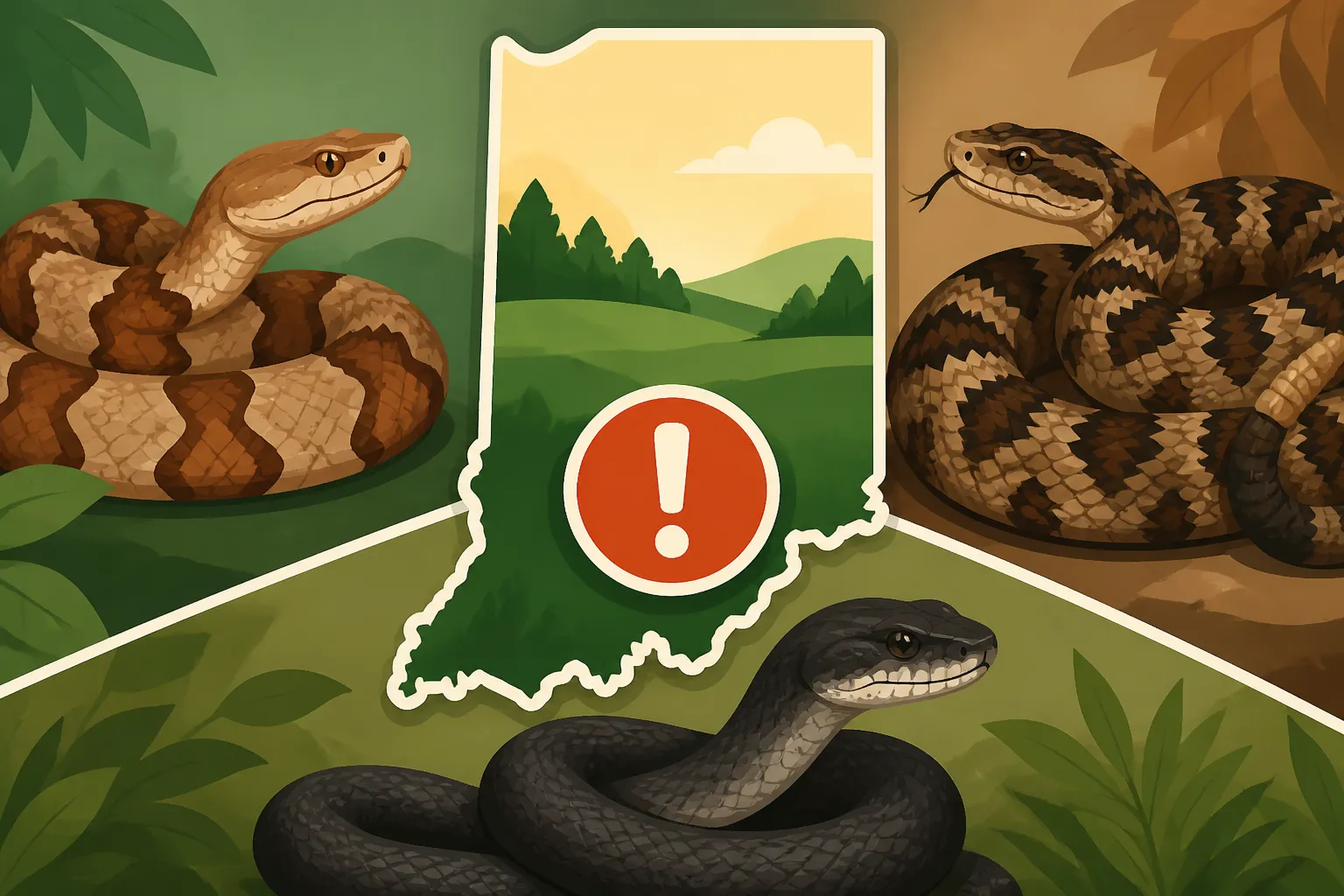
Indiana’s four venomous snakes are the copperhead, timber rattlesnake, eastern massasauga, and cottonmouth. They share a feature that helps group them but is not a safe way for a member of the public to identify them at close range. Indiana Department of Natural Resources, Division of State Parks explains: All are pit vipers. The heat-sensing pits are near the eyes, but seeing them clearly would mean getting closer than is sensible.
Look at the whole situation instead: the snake’s pattern, its general body shape, its location, and whether it has a rattle. None of these clues, taken by itself, proves a snake is venomous or harmless. A rattle can be hard to see or hear, and color can shift with lighting, age, or the condition of the animal. Even a good photograph may not capture the details needed for a reliable identification.
If a snake is on a path, step back and give it a route to move away. If it is beside a home, keep children and pets away and avoid blocking its way. If it is inside a building or presents an immediate concern, contact a qualified wildlife professional rather than trying to catch it. For more on practical first steps, see Found a Snake in Your Indiana Yard or House? Start Here.
How to Recognize a Copperhead
Copperheads are the venomous snakes Indiana residents are most likely to hear about as a possibility. Indiana DNR’s wording is: Only copperheads can be considered somewhat common, in southern and west-central Indiana. That regional description does not make a snake identification certain, and it does not mean every patterned snake in those areas is a copperhead.
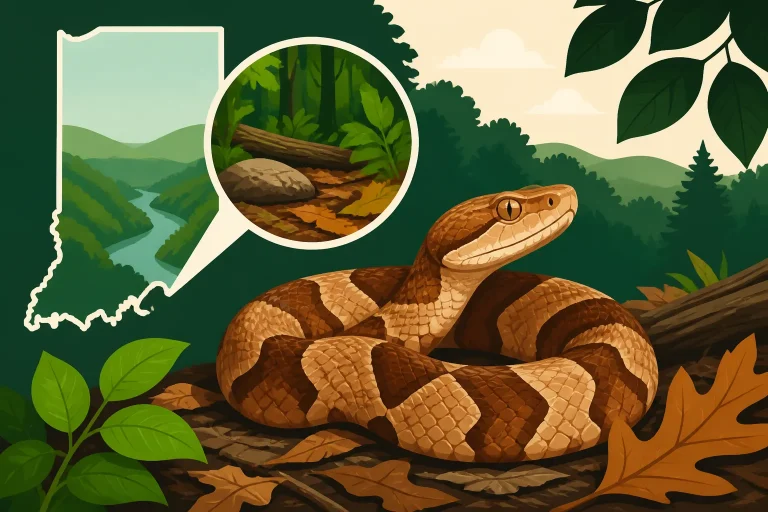
The usual visual clues are a coppery-colored head and reddish-brown bands shaped like hourglasses. Seen from above, an hourglass band is narrower across the snake’s back and broader down the sides. The pattern may be muted or difficult to read if the snake is curled, partly hidden, wet, or viewed in poor light.
The Northern copperhead’s bands are narrow along the back and wide on either side. That shape helps distinguish the pattern from the saddlelike bands seen on watersnakes, though a brief glance may not show the whole band clearly. Compare the pattern without getting closer: if you can’t see it well from a safe distance, don’t try to improve the view by approaching.
The head’s color can be a useful clue, but it should not be used alone. Lighting can make a head look darker or lighter than it is, and several nonvenomous snakes can look brown or reddish. A broad head is not proof either. Snakes may flatten their heads when threatened, and head shape changes with posture and angle.
Copperhead markings can resemble those of other Indiana snakes, especially when the animal is young or only partly visible. A watersnake may have dark bands or blotches, and some harmless snakes have reddish or brown coloring. Pattern details matter, but even a person who knows the usual field marks can misread a distant, moving, or obstructed snake. If the identification would affect whether you approach, handle, or try to remove the snake, it is not a safe basis for action.
Do not pick up a copperhead, even if it seems injured, sluggish, or dead. Keep pets and children back, and let the snake move off if it has an open route. If it is in a place where people cannot safely avoid it, ask a qualified professional about removal. For a closer comparison with a common look-alike, see Copperhead Bands vs Watersnake Bands: Reading the Hourglass and Is That a Copperhead or a Watersnake by the Creek?.
How to Recognize a Timber Rattlesnake
The timber rattlesnake is a large, heavy-bodied pit viper associated with wooded habitat. Its pattern often includes dark bands against a lighter background, and it may have a rust-colored stripe along the back. The amount of contrast and the overall color can vary, so an animal that does not match a familiar picture exactly should not be ruled out on that basis.
The tail rattle is an important clue when it is visible. But a rattle is not a dependable pass-or-fail test. It may be hidden in grass or leaves, and a snake may not rattle when someone expects it to. Don’t wait for a sound or move closer to inspect the tail. A snake that does not appear to have a rattle is not automatically harmless.
Timber rattlesnakes can be confused with large nonvenomous snakes, particularly when viewed from far away or through vegetation. Dark bands, a broad body, and a long shape are not enough to confirm the species. If the snake’s head or tail is hidden, the pattern is unclear, or you can only see part of the animal, there may not be enough information for a confident identification.
If you encounter a suspected timber rattlesnake outdoors, stop and give it space to retreat. Don’t try to get a better look by stepping around it, moving branches, or taking a close-up photo. On a trail, wait at a distance for the snake to move away if there is room to do so safely; if not, turn back and choose another route.
You can read about field marks and habitat in Spotting a Timber Rattlesnake in Indiana: Field Marks and Habitat. That information can help you understand what you may be seeing, but it should not replace distance and caution when the snake is in front of you.
How to Recognize an Eastern Massasauga
The eastern massasauga is a rattlesnake, but it can look different from the familiar image of a large, boldly patterned rattler. It is generally smaller and more compact, with a light gray or tan background and dark rounded blotches along the back and sides. Its small rattle may be difficult to notice, especially if the tail is hidden or the animal is seen from far away.
That combination of blotches and a rattling tail can help distinguish a massasauga from some other snakes, but neither feature is conclusive by itself. A watersnake can have a blotched or banded pattern, and the rattle may not be visible. Do not approach the snake to inspect its tail, and don’t rely on a lack of rattling as evidence that it is harmless.
The massasauga is associated with wet places such as marshes and other wetlands. Habitat can offer context, but it is not a field test: nonvenomous snakes also live near water, and a snake may travel beyond the spot where someone expects to find it. A location can make a possibility more or less plausible without proving a species.
If you think you have seen a massasauga, leave it alone and avoid disturbing the surrounding plants or ground. Do not try to capture it, move it, or take it home for identification. If the snake is close to people or in a location where it cannot be left undisturbed, contact a qualified professional or the wildlife agency for guidance. The Small Rattlesnake in Northern Indiana? The Eastern Massasauga explains why the species can be mistaken for other snakes and what to do with a possible sighting.
How to Think About a Cottonmouth Report
Cottonmouths are included among Indiana’s four venomous snake species, but a snake reported as a cottonmouth should not be identified by location or a single visual impression. People often use “water moccasin” as another name for a cottonmouth, and sightings around water can prompt that label even when the snake may be a watersnake.
A cottonmouth may show dark bands, a thick body, and a pale mouth when it holds its mouth open defensively. Those features are not an invitation to get closer and check. Watersnakes can also look dark, banded, or heavy-bodied, especially when wet or seen in shaded water. A snake’s defensive posture is not a reliable way for a bystander to tell whether it is venomous.
The white-mouth display is not a required clue. A snake may not open its mouth, may be partly hidden, or may be seen from an angle that does not show the inside. Similarly, a dark, uniform-looking snake is not necessarily a cottonmouth. Color and posture can change how an animal appears, and photographs can remove useful context such as scale, lighting, and the full body pattern.
When an unfamiliar snake is beside a pond, stream, or wetland, keep back and give it room. Avoid entering the water or reaching into vegetation to check where it went. If the snake is in a place where people or pets are likely to encounter it, keep them away and ask a qualified professional for help rather than trying to handle it.
For background on the name and common confusion, see Water Moccasin or Cottonmouth? One Snake, Two Names and Northern Watersnake or Cottonmouth? Clues That Matter in Indiana. These comparisons can help explain the differences, but a close or uncertain encounter still calls for distance, not a closer inspection.
Avoid Common Identification Traps
Several popular shortcuts sound convincing but are unreliable. The shape of a snake’s head, whether its pupils look round or slit-like, or whether it appears calm does not make it safe to handle. These details can be hard to see at a distance, and a snake’s posture can change its apparent shape. Never use a single feature to decide that an unknown snake is harmless.
Color alone is another weak shortcut. Copperheads are associated with copper and reddish-brown tones, but brown snakes are not all copperheads. Dark snakes are not all rattlesnakes or cottonmouths. A faded or muddy animal may look quite different from a clean photograph, while bright light and shadows can distort a pattern.
A snake’s behavior is not a reliable identification clue either. A snake that stays still, retreats, or holds its ground may be responding to its surroundings. Do not interpret stillness as permission to approach. Do not try to provoke a defensive display to see whether the snake rattles, flattens its head, or opens its mouth.
Common harmless look-alikes
Indiana’s nonvenomous snakes include familiar species that people may see in yards, gardens, and near water. According to the Indiana Department of Natural Resources, Division of State Parks, common nonvenomous snakes include gartersnakes, usually marked by three light stripes, and watersnakes, which have dark crossbands and are often found near water. These patterns can still be mistaken for venomous markings from a poor angle or at a distance.
Watersnakes are a particularly common source of confusion. Their bands can look dark and bold, but copperhead bands have an hourglass form, while watersnake bands are more saddlelike. That distinction can be useful if the entire pattern is visible. It is less helpful if the snake is coiled, submerged, hidden in weeds, or seen only briefly.
Gartersnakes often have stripes running along the body, but stripes can be faint, interrupted, or partly concealed. The presence of a stripe may support an identification, but it does not justify touching the snake to check. For a broader overview of everyday species, see Common Garter Snakes, Watersnakes and Other Everyday Indiana Snakes.
Why photos can mislead
A photo may not show the whole pattern, the snake’s size, or the angle needed to distinguish bands. A close zoom can make the head seem larger than it is, while a distant photo may blur the markings that matter. Images taken in shadow or through glass can alter color. A single image is often useful for narrowing possibilities, not for proving that a snake is safe.
If you already have a photo taken from a safe distance, preserve it and share it with a qualified professional or wildlife agency if identification is needed. Do not return to the area to take a better picture. You can find practical photo tips in Photographing a Snake for an ID Without Getting Close in Indiana.
What to Do When You Find a Snake
A calm response protects people, pets, and the snake. In most outdoor encounters, the most useful action is to stop moving toward it and allow space for it to leave. Don’t try to kill it, pin it down, or carry it away. Handling exposes you to a bite and can also make identification harder by hiding the snake’s natural posture and pattern.
- Pause and step back. Give the snake room and keep your hands and feet away. If you are on a trail, don’t step over it or reach past it.
- Keep others back. Calmly move children and pets away without crowding the snake or trying to block its route.
- Let the snake leave if it can. Avoid poking vegetation, moving objects, or forcing it from a hiding place.
- Get help if the location creates an ongoing risk. Contact a qualified wildlife professional or the wildlife agency for guidance. Use the official website to find current contact details.
- Do not handle it to confirm the species. If you cannot confidently identify the snake from a safe distance, treat it as unknown.
If a snake is indoors, keep people and pets away from the room and avoid trying to catch it with a container, broom, or other object. Close off access to the room only if you can do so without going near the snake. A professional can advise on safe removal. Snake Loose Inside the House: Calm Steps for Indiana Homeowners covers that situation in more detail.
If someone is bitten by a suspected venomous snake, call 911 or Poison Help at 1-800-222-1222. Do not try to capture or kill the snake to identify it. If it can be done without approaching, a photo from a safe distance may help later, but getting medical help takes priority. For bite-specific guidance, see Snakebite in Indiana: The First Steps While Help Is on the Way.
Frequently Asked Questions
Are all four venomous snakes rattlesnakes?
No. The timber rattlesnake and eastern massasauga are rattlesnakes. Copperheads and cottonmouths do not have rattles. A missing or unseen rattle does not establish that a snake is harmless.
Is a broad, triangular head enough to identify a venomous snake?
No. Head shape can change with posture, and some nonvenomous snakes flatten their heads when threatened. Keep your distance rather than using head shape as a handling test.
Are snakes near water likely to be cottonmouths?
Not necessarily. Watersnakes are also often found near water and can have dark bands. Location is context, not proof of species. If you cannot identify the snake confidently from a safe distance, leave it alone.
Should I move a snake that looks injured?
No. Don’t handle an unknown snake, even if it appears injured or motionless. Keep people and pets away, and ask a qualified professional or wildlife agency for guidance.
Sources
- Indiana Department of Natural Resources, Division of State Parks (checked November 20, 2026)
- Indiana Department of Natural Resources, Division of State Parks — Fish and Wildlife: Snakes (checked November 20, 2026)
- Indiana Department of Natural Resources, Division of State Parks — Fish and Wildlife: Amphibians and Reptiles FAQs (checked November 20, 2026)
Disclaimer
This article is for general informational purposes only and does not constitute professional advice. Laws, prices and regulations vary by location and change over time. Consult a qualified professional for guidance on your specific situation. Indiana Critter Guide is not a government agency or pest control company and is not affiliated with any government agency.