Snakebite in Indiana: The First Steps While Help Is on the Way
A snakebite can leave you unsure what happened, what kind of snake was involved, and what to do before help arrives. The priority is to get urgent guidance, stay focused, and avoid turning an uncertain identification into a risky close encounter. Here are the immediate steps, what information may help responders, and how to handle the situation at a state park or elsewhere in Indiana.
Start with urgent help and a calm response
If a snake may have been venomous, or you cannot identify it with confidence, treat the bite as urgent rather than trying to settle the identification first. If the bite is an emergency, call 911 or Poison Help at 1-800-222-1222. If you are at an Indiana state park and the snake may have been venomous or its identity is uncertain, the Indiana Department of Natural Resources, Division of State Parks says to call or have a friend call 911 and contact property staff.
The state park instruction is specific to that setting: property staff can be contacted along with emergency services. Elsewhere, tell the dispatcher where the bite happened and follow the instructions you receive. Do not delay that contact while trying to take a photograph, find the snake, or compare its markings with an online image.
The Indiana Department of Natural Resources, Division of State Parks gives this first instruction after a bite: Keep calm. That can be easier said than done, especially when someone is frightened or the snake is still nearby. A calm, direct approach helps people focus on the immediate tasks: getting help, keeping others from approaching the snake, and communicating useful details.
If another person is present, ask them to make the call while you stay with the bitten person. If you are alone, make the call yourself as soon as you can do so safely. Avoid moving closer to the snake to get a better look. If it has left, do not search for it. A bite can be stressful, but pursuing or handling the animal creates another opportunity for contact without helping responders provide care.
When you speak with emergency services, state that a snakebite has occurred and give the location as clearly as possible. If you are in a large outdoor area, campground, trail system, or park, describe the nearest recognizable place or route and ask a companion to meet responders at a safe, easy-to-find point if needed. Keep the conversation focused on what happened and where help is needed; the dispatcher can ask follow-up questions.
If you are uncertain whether the bite came from a snake, say that rather than presenting a guess as fact. The same applies to the snake’s identity. A quick, honest description is more useful than a confident but unverified label. For help thinking through identification without approaching an animal, see What Snake Is This? Identifying Snakes Around Indiana Homes. If the concern is specifically whether an Indiana snake might be venomous, Venomous Snakes in Indiana: How to Recognize Each Species provides related identification context, but it should not delay urgent help after a bite.
What to do while help is on the way
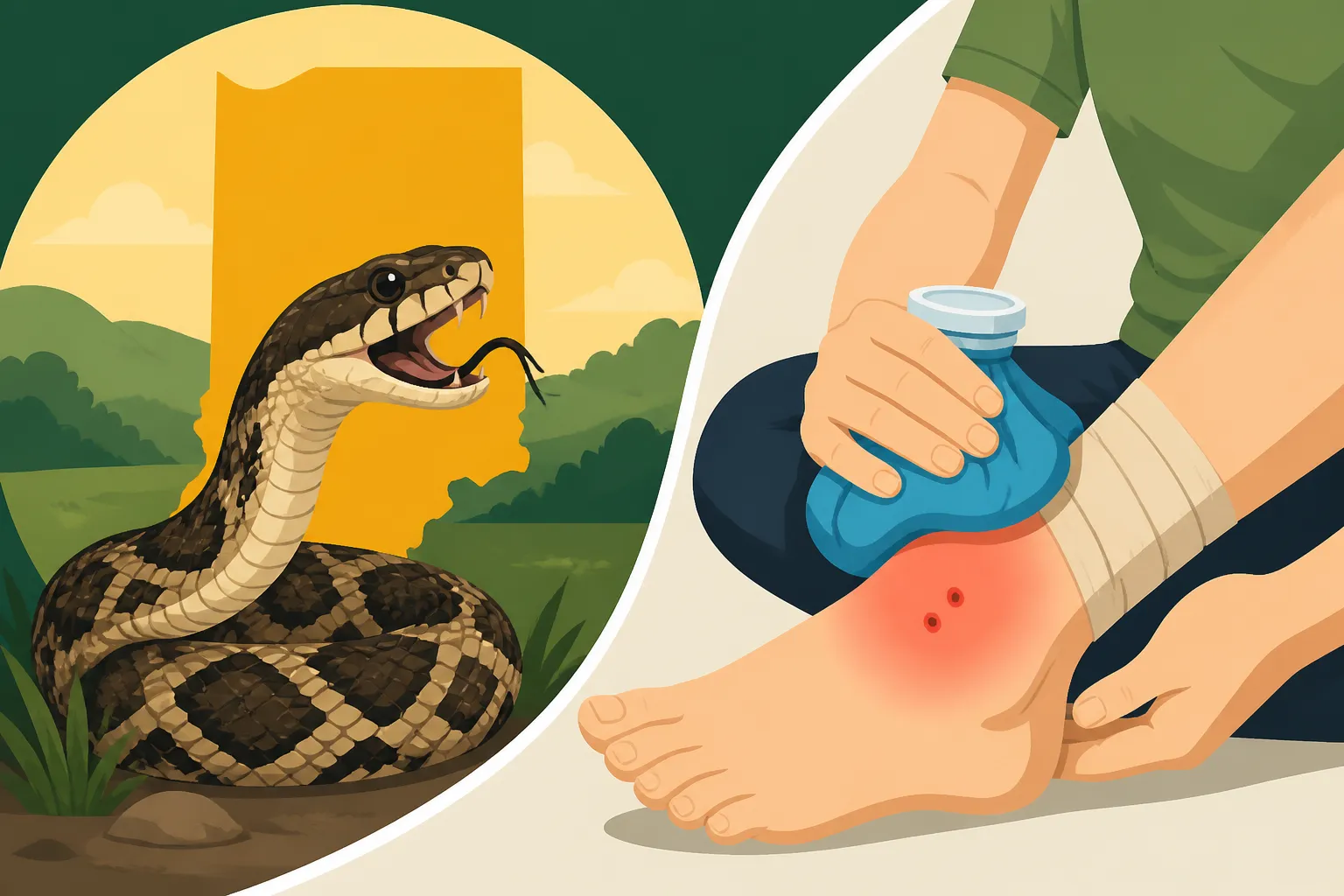
The Indiana Department of Natural Resources, Division of State Parks says to clean the bite area thoroughly with soap and water as soon as possible. This is a specific first step in its guidance. If soap and water are not immediately available, do not let the search for supplies delay contacting emergency services or Poison Help. Follow the instructions provided by responders.
After that immediate step, keep the situation organized rather than adding unverified treatments. Online advice about bites can be contradictory, and an action that seems intuitive may not be appropriate. Do not treat a webpage, a friend’s memory, or a social media post as a substitute for instructions from emergency services or Poison Help. If you have already received professional guidance, follow that guidance rather than trying to combine it with separate suggestions.
Try to keep the bitten person in a safe place where responders can reach them. That does not mean moving closer to the snake or going back to the spot where the bite occurred. If the snake is nearby, create distance and keep other people away from it. If the person is already in a location where they can be reached safely, avoid creating unnecessary activity around them. The central aim is to get professional help and avoid further contact with the animal.
A companion can take on practical tasks that do not involve handling the snake: contacting help, relaying directions, keeping the path clear, and noting observations. If several people are present, decide who is speaking to responders and who is staying with the bitten person. This can prevent everyone from calling at once or giving conflicting accounts. If no companion is available, prioritize the call and follow the dispatcher’s direction.
While waiting, avoid guessing at how serious the bite is from its appearance alone. The look of a bite does not establish which snake was involved or what care is needed. A small-looking mark is not a reliable reason to dismiss the incident, and a dramatic-looking mark does not identify the snake. Give the facts you can observe and let medical professionals assess the situation.
If you are unsure what to do after the initial call, ask the dispatcher or Poison Help directly. Keep the phone available and make sure someone can hear any further instructions. If the location, access route, or circumstances change, communicate that change rather than assuming responders already know it. The person providing care may need a clear route to the scene, particularly in a park or another outdoor area.
For the specific state park setting, Snakebite at an Indiana State Park: 911 and Property Staff covers the park-related contact step. For more about what to avoid during the wait, Snakebite Mistakes to Avoid While Waiting for 911 in Indiana is a related resource. The safest approach is not to try several competing methods; it is to follow the official direction you receive for the actual situation.
Record what you observed without approaching the snake
The Indiana Department of Natural Resources, Division of State Parks advises people to make note of the markings, color, behavior and habitat of the snake. These observations can help communicate what was seen, but they do not justify approaching, touching, trapping, or trying to catch the animal. If the snake is still present, keep a safe distance and leave identification to people who can assess it without creating another exposure.
A useful description is specific and modest. Report what you actually noticed: the general pattern, the colors visible in the light, whether the snake was moving or still, and the kind of place where it was seen. If you did not see a particular detail clearly, say so. “I could not see the head” or “the color was hard to judge” is more reliable than filling in the gap with a guess.
Think through the setting from where you were when the bite happened. Was the person on a trail, near water, beside a structure, in a yard, or in another recognizable area? What was the snake doing immediately before it was noticed? Was it seen at all, or is the identification based only on a report from someone else? Those distinctions help responders understand how certain the account is. They also prevent a mistaken identification from becoming the central focus of the call.
A photograph may seem helpful, but getting one is not worth moving closer or delaying help. Only take a picture if it can be done from a safe distance without changing the situation. Do not follow the snake for a better angle, block its route, or handle it for a close-up. If the snake disappears before you can make a safe observation, do not search for it. You can still tell responders what you remember and state plainly that the animal was not available for a closer look.
Do not rely on a single feature to label the snake. Color can look different depending on light, distance, and the observer’s stress. Patterns may be partly hidden, and a quick glimpse may not show the body clearly. Even people familiar with local snakes can be mistaken when viewing an animal briefly. If you are uncertain, make that uncertainty explicit instead of using a species name as if it were confirmed.
It can help to separate observations from conclusions when talking with responders:
- Observation: “I saw a patterned snake beside the trail.”
- Uncertainty: “I could not see its head clearly.”
- Context: “The bite happened near the same spot.”
- Conclusion to avoid presenting as fact: “It was definitely a particular species,” unless someone qualified has confirmed that identification.
These are not extra medical steps; they are ways to give a clear account without putting anyone at greater risk. If no one saw the snake, say that too. A bite can still be treated as urgent without identifying the animal.
For safe identification context, Photographing a Snake for an ID Without Getting Close in Indiana explains why distance matters when documenting a snake. Pit Viper or Not? Heat Pits, Eye Shape and Other Indiana Clues discusses features people may try to use, but checking features should never replace urgent care or require handling an unknown snake.
Keep the scene safe and the communication clear
The first priority is not to secure the snake. It is to get help for the person and prevent another person from being bitten. Do not try to catch, kill, move, or corner the animal. Do not ask a child or bystander to approach it. If the snake is in the immediate area, guide others away from it without closing the distance yourself.
If the bite happened during an outdoor activity, do not assume the trail, shoreline, or campsite is safe just because the snake is no longer visible. Keep the group together in a safe place and tell responders where the animal was last seen. Avoid making a broad claim that the snake is gone if nobody has confirmed that. If people need to leave the area, use a route that does not require approaching the snake.
It is useful to have one person manage communication when possible. That person can give responders the location, describe what was seen, and relay any new information. Other companions can keep the immediate area clear and help make the location easier to find. Avoid sending multiple people to look for the snake or to meet responders by separate routes unless emergency personnel direct it.
In a park, property staff may be able to help identify the right access point or provide location context, but contacting staff does not replace calling for emergency help. In a home or neighborhood, give the address or a clear location description and explain whether the snake remains visible. In a remote area, use known landmarks and describe the route taken. If you are not certain of the exact location, say so and share the closest reliable reference rather than guessing.
Keep information simple and factual. Responders may ask what happened, when it happened, where the person is, whether the snake was seen, and what it looked like. Answer only what you know. If someone else witnessed the bite or saw the snake more clearly, share that person’s account directly when possible, or relay it as a secondhand observation.
Do not let a discussion about whether the snake was “probably harmless” delay care. The same goes for a disagreement among companions about color or pattern. The purpose of observations is to help professionals, not to make bystanders responsible for a medical decision. When a snake’s identity is uncertain, say so and let responders make the next call.
If the bitten person is a child, an older adult, a visitor, or someone who cannot clearly describe what happened, tell the dispatcher that the account is incomplete. Do not use a limited description as a reason to wait. The person arranging help can also gather the information they do know, such as the location and whether anyone saw the snake, while remaining focused on the instructions from professionals.
Why a confident snake identification is not required
People often want a species name before they call for help. That urge is understandable: identifying the snake can feel like the quickest way to judge the situation. But a rushed identification is not a safe substitute for professional assessment. If the snake was seen only briefly, if the light was poor, or if the person did not see it at all, the most accurate description may simply be that its identity is unknown.
Avoid using a single image, an online comparison, or a memory of a similar snake to rule out concern. Photographs may omit important features, and an animal’s appearance can be hard to judge at a distance. A snake’s location can add context but does not prove what it is. The right way to describe uncertainty is to state what was seen and what was not.
A snakebite and a snake sighting are also different problems. If a snake is seen but no one is bitten, the main concern may be keeping distance and arranging appropriate help for the animal or location. If someone has been bitten, do not let the identification task become a reason to delay urgent guidance. The immediate priority is the person, not collecting a specimen or producing a perfect photograph.
If a companion believes the snake was nonvenomous, still describe the basis for that belief and let professionals decide what to do with the information. Do not argue over a label while help is being arranged. People may use local names incorrectly or confuse similar-looking snakes. A clear statement such as “one person thought it was a watersnake, but nobody confirmed it” preserves the information without overstating certainty.
The same caution applies when there is no visible snake after the bite. Do not assume that a person’s account is unreliable simply because the animal was not captured on camera. Explain what the person felt or saw and when the snake was noticed, without embellishing the account. Responders can work with incomplete information; inventing certainty makes it harder to understand what actually happened.
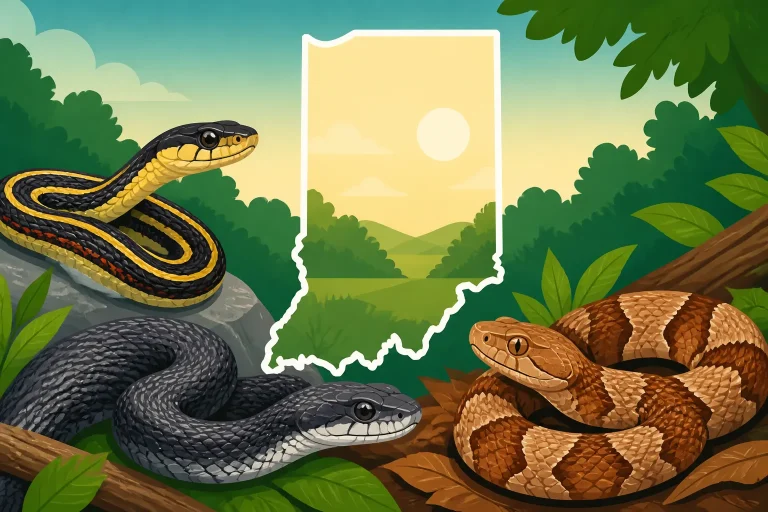
Related Indiana resources can help with general recognition questions after the urgent situation is addressed. Common Garter Snakes, Watersnakes and Other Everyday Indiana Snakes offers context on common species, while Leave It Alone: Why Unknown Snakes Are Best Not Handled in Indiana explains why an unknown snake should be given space. Neither identification nor a reassuring guess should take priority over contacting help after a bite.
Adapting the response to where the bite happened
The basic priorities remain the same whether the bite happens near a house, along a trail, by water, or at a park: seek urgent guidance, follow professional instructions, and keep people from approaching the snake. The location changes how you explain access and who may be able to help with the site.
At an Indiana state park
If the bite happens at an Indiana state park and the snake may have been venomous or its identity is uncertain, the Indiana Department of Natural Resources, Division of State Parks advises contacting property staff as well as emergency services. Tell staff where the person is and where the snake was last seen, if it was seen. Do not leave the bitten person to search for staff or to find a better view of the animal. A companion can relay information while the person receiving care follows emergency guidance.
Use recognizable park features to describe the location, but do not wander toward the snake to confirm a landmark or route. If the location is hard to explain, state what you know and allow the dispatcher or staff to ask questions. A clear, approximate description is better than an unsafe trip back to the scene.
On a trail or in a remote outdoor area
Tell responders that the bite happened away from a vehicle or easy access point. Describe the route and any visible landmarks you remember. If your group is spread out, bring people together in a safe place rather than asking them to search separately. If someone has a map or knows the trail, have that person communicate the route without leaving the bitten person unattended unless emergency personnel tell you otherwise.
Avoid moving into thick vegetation or another uncertain area to look for the snake. A safe route out matters more than a close identification. If you need to describe where the animal went, give the last location where it was seen rather than following it.
At home or near a building
If the bite happened in a yard, garage, shed, or other area around a building, keep other people and pets away from the snake’s last known location. Give responders the address and explain whether the animal is still visible. Do not try to sweep, trap, or carry the snake outside. A person trying to remove it can create another bite risk and distract from getting help.
If the animal has gone out of sight, do not search under objects or inside stored materials. Report that it was last seen near the building and describe the surroundings from memory. The snake’s absence from view does not change the need to act on the bite.
Common delays and how to avoid them
A stressful situation can prompt people to do too much: search for the snake, debate its identity, collect photos, look up home remedies, or move the bitten person without a clear reason. The most useful response is usually simpler. Contact urgent help, follow the instructions you receive, and give an accurate account of what happened.
Waiting to see whether the bite seems serious. A person should not rely on the bite’s appearance or on a guess about the snake to decide whether to seek help. If the identity is uncertain, say that when you contact emergency services or Poison Help. Let qualified professionals assess the situation.
Trying to catch the snake. Do not risk another bite to obtain a specimen or a close-up. A dead or captured snake is not worth creating a second exposure. A description from a safe distance is enough to report what was observed.
Relying on memory alone when a witness is available. If another person saw the snake more clearly, ask them to describe it directly to responders if practical. Keep the account factual and identify who saw what. Do not transform a secondhand guess into a confirmed identification.
Searching the internet before calling. Identification pages can be useful for general learning, but they cannot assess a person who has just been bitten. Do not compare photos while urgent contact is being delayed. If you use an identification resource later, treat it as background information, not a medical decision.
Trying several different remedies. Advice passed among friends or found online may conflict. Avoid adding steps that have not been recommended by the professionals handling the call. Ask the dispatcher or Poison Help what to do next and follow that direction.
Assuming the bite was harmless because the snake is gone. Whether the snake can still be seen does not answer what happened. Tell responders whether anyone observed it and whether the identification is certain. Do not downgrade the concern simply because there is no animal to show.
For more on waiting safely and avoiding common errors, see Snakebite Mistakes to Avoid While Waiting for 911 in Indiana. If you are trying to decide who can help with a snake after the immediate medical response, Can You Move a Snake Yourself in Indiana, or Who Removes It? addresses the separate question of snake removal. Do not let arranging removal distract from urgent care for the bitten person.
Frequently Asked Questions
Should I call if I do not know what kind of snake bit someone?
Yes. Do not wait to identify the snake before seeking urgent guidance. Tell emergency services or Poison Help that the species is uncertain and share only the details you actually observed.
Should someone try to bring the snake to the hospital or show it to responders?
No. Do not handle, catch, or transport the snake. A safe description may be useful; creating another opportunity for a bite is not.
What if the bite happened at an Indiana state park?
Contact emergency services and, when the snake may have been venomous or its identity is uncertain, notify park property staff as well. Give a clear location and do not approach the snake to improve the description.
What if the bite mark looks small or the snake has disappeared?
Neither detail identifies the snake or determines what care is needed. Share what happened and what is uncertain with the professionals you contact, and follow their instructions.
Sources
- Indiana Department of Natural Resources, Division of State Parks (checked November 20, 2026)
Disclaimer
This article is for general informational purposes only and does not constitute professional advice. Laws, prices and regulations vary by location and change over time. Consult a qualified professional for guidance on your specific situation. Indiana Critter Guide is not a government agency or pest control company and is not affiliated with any government agency.