Copperheads in Southern Indiana: Where They Live and How to Spot One
A snake near a trail, woodpile, or garden can be difficult to identify at a glance, and guessing from color alone is risky. Copperheads occur in part of Indiana, but they are not the only snakes with bands or brown coloring. This article explains where they may be encountered, what clues to compare, and how to respond without getting closer.
Where copperheads live in Indiana
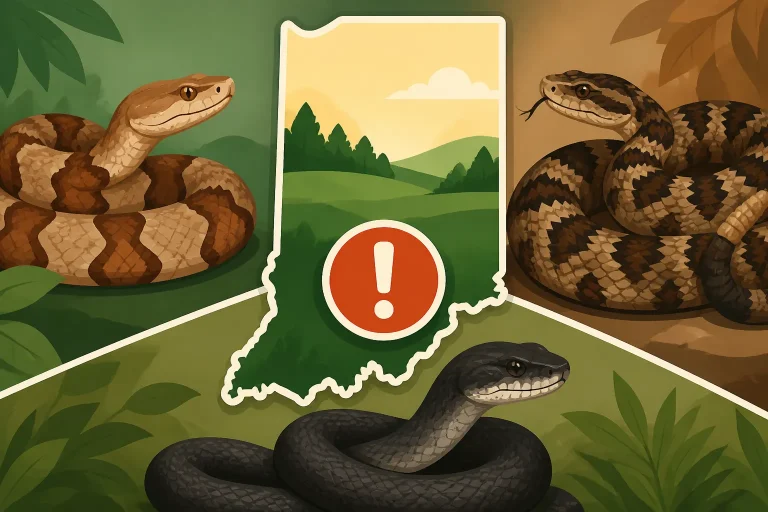
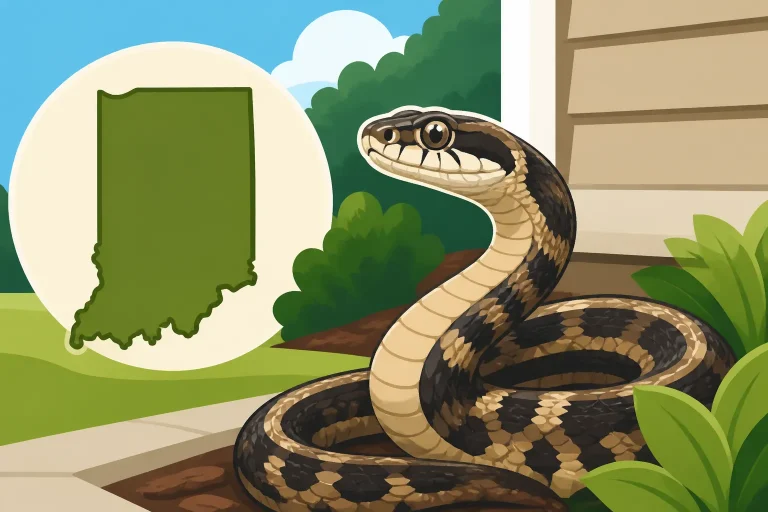
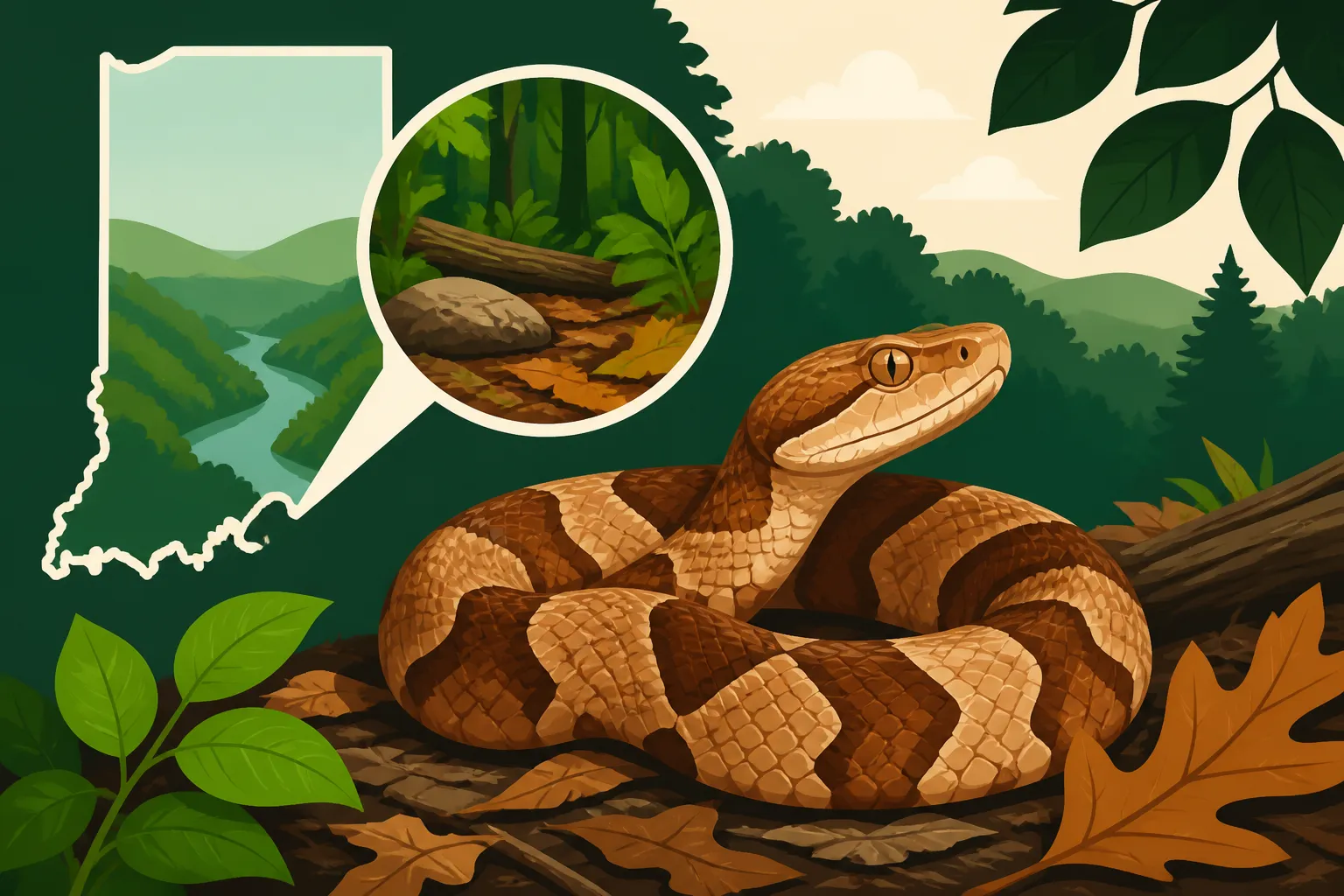
The Indiana Department of Natural Resources, Division of State Parks, says copperheads are only found in southern half of the state. That is a useful starting point, not a promise that a copperhead will be present in any particular southern Indiana yard, park, or trail. Their distribution is regional; a single sighting or a suitable-looking patch of habitat does not tell you that one is nearby.
The Northern copperhead is the Indiana Department of Natural Resources, Division of State Parks’ Indiana’s most common venomous snake. “Most common” is a comparison among the state’s venomous snakes, not an indication that copperheads are common everywhere in Indiana. The agency also describes them as somewhat common in southern and west-central Indiana. Its distribution information does not make Indianapolis a typical place to expect them.
Copperheads are associated with natural areas where they can find cover and prey. In the field, useful broad clues include wooded ground, rocky or brushy edges, and places where leaves, logs, or stones create hiding cover. Those features are not proof of a copperhead. Many harmless snakes use similar shelter, and a snake can move through an area without matching a simple habitat checklist.
The Indiana Department of Natural Resources considers habitat one of several identification clues, alongside a snake’s size, coloration, patterns, and body or head shape. In practice, that means habitat can help you decide which species descriptions to compare, but it should not settle the identification. A brown, banded snake in a wooded area is not automatically a copperhead.
The boundary of the region is not a dependable way to identify an individual snake, either. A sighting near the edge of a known range could be a different species, and a location alone cannot confirm what you saw. Use local range information as context, then look at the animal’s features from a safe distance. If the identification remains uncertain, leave it alone.
For a broader overview of where Indiana’s venomous snakes occur, see Where Venomous Snakes Live in Indiana, Region by Region. If you are trying to make sense of a snake seen around a home rather than in the field, Found a Snake in Your Indiana Yard or House? Start Here covers practical next steps.
How to spot a copperhead without getting close
The most useful field clue is the body pattern, but it should be assessed alongside other features rather than in isolation. The Indiana Department of Natural Resources, Division of State Parks, describes the Northern copperhead’s bands as narrow along the back and wide on either side, unlike the water snake’s saddlelike bands. The pattern can look like a series of darker hourglass shapes across a lighter body.
Indiana DNR’s snake profiles describe identification clues such as size, coloration and patterns, body or head shape, and habitat; compare those features with the species descriptions and illustrations, including the hour-glass pattern of reddish brown bands on its body. That comparison is more reliable than trying to make a decision from one feature in a quick glance.
A coppery-colored head is another clue used in copperhead identification. However, color can be affected by light, distance, the snake’s posture, and the background. A brown or reddish snake is not necessarily a copperhead, and a snake that does not look copper-colored in a dim or brief view cannot be ruled out on that basis alone.
Head shape can also be misleading. People often try to identify a venomous snake from the shape of its head, but a view from above, a partly hidden head, or the animal’s position can make this difficult to judge. Don’t approach to get a better look at the head, and don’t rely on one visual feature as a yes-or-no test.
A useful observation is the pattern as a whole: how the bands cross the back, how wide they are along the sides, and how the overall colors and body shape compare with a trusted species description. Take in the setting too, but treat habitat as supporting information rather than a verdict. The goal is not to prove a snake’s identity at close range; it is to decide whether you can confidently identify it without disturbing it.
If you can’t identify the snake confidently, keep your distance and do not handle it. That advice applies even if you think it might be harmless. A safe identification requires more than a quick impression, and getting nearer can create risk without making the answer certain.
For a closer explanation of the band pattern, see Copperhead Bands vs Watersnake Bands: Reading the Hourglass. For a broader comparison of Indiana’s venomous species and their identifying traits, see Venomous Snakes in Indiana: How to Recognize Each Species. If you need an identification approach that does not require approaching the animal, Photographing a Snake for an ID Without Getting Close in Indiana may help.
Copperheads and the snakes they are often confused with
Banding alone is not enough to identify a copperhead. Indiana has nonvenomous snakes with dark markings, and some can appear brown or banded depending on the light, distance, and angle. Compare the full set of visible features rather than deciding from a single color or mark.
| What you notice | Why it may help | What it cannot prove |
|---|---|---|
| Bands that look narrow along the back and wider at the sides | This matches a copperhead pattern described by the Indiana Department of Natural Resources, Division of State Parks | A quick or obstructed view may distort the pattern; keep your distance |
| A coppery-colored head | This is one clue associated with copperheads | Color alone does not confirm a species |
| Dark crossbands on a snake near water | Watersnakes may have this pattern and often occur near water | Being near water does not, by itself, identify a watersnake |
| Three light stripes along a snake’s body | Gartersnakes are usually marked by these stripes | A brief view or poor light may hide or blur stripes |
| A snake in a wooded, rocky, or brushy area | Habitat can help guide which species descriptions to check | Other snakes also use cover, so habitat is not a confirmation |
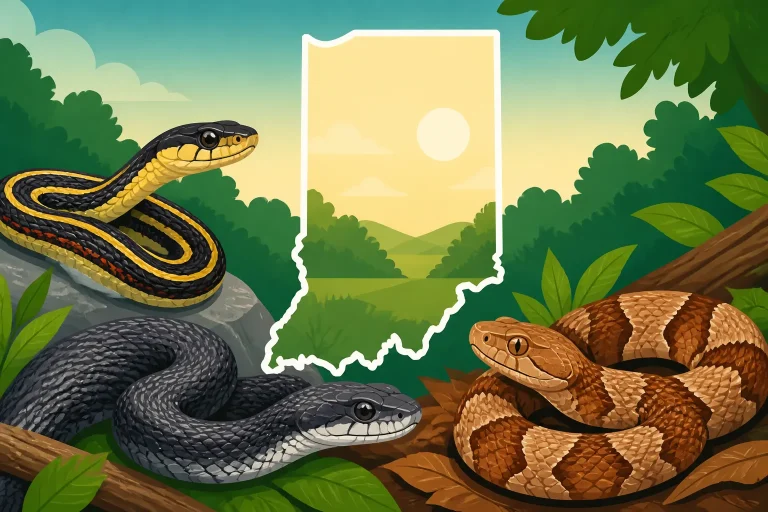
Gartersnakes and watersnakes are common nonvenomous snakes you may encounter in Indiana. Gartersnakes are usually marked by three light stripes, while watersnakes have dark crossbands and are often found near water. Copperheads also have a coppery-colored head and reddish-brown hourglass bands. These are useful comparisons, but none is an invitation to get closer or handle a snake.
A watersnake’s markings can be especially confusing when the animal is partly submerged, curled, or seen from above. Its crossbands may look different from one angle to another. A copperhead’s body pattern can also be difficult to read if the snake is in shadow or among leaves. If you cannot see enough detail to compare the pattern reliably, treat the identification as uncertain.
The Indiana Department of Natural Resources, Division of State Parks, lists four venomous species, but says Only copperheads can be considered somewhat common in southern and west-central Indiana. That regional context can help avoid assuming that every banded snake is a copperhead, but it does not make it safe to handle a snake you cannot identify.
For more side-by-side clues, see Northern Watersnake or Cottonmouth? Clues That Matter in Indiana and Snakes That Look Like Copperheads in Indiana: Milk Snakes and More. If you have a snake at home and the species is unclear, What Snake Is This? Identifying Snakes Around Indiana Homes is a relevant next read.
What to do when you see a copperhead or an unknown snake
The safest response is simple: stop, give the snake room, and let it move away if it can do so without being cornered. Don’t try to pick it up, push it with a tool, trap it, or move it for a photograph. Even a snake that appears still may move suddenly when approached or disturbed.
If you are on a trail, step back along the route you came from if that can be done without getting closer. Don’t step over the snake or try to make it move. Give it time and space to leave. If the encounter is in a public area and the snake is in a place where other people may approach it, alert the appropriate property staff or contact a qualified professional through official contact information.
At home, keep people and pets away from the immediate area. Don’t try to herd a snake toward an exit or reach behind stored items to locate it. If it is indoors, close off access to the room if you can do so without approaching the snake, then seek help from a qualified wildlife professional. A snake in a house can disappear into a gap or clutter, so avoid searching by hand.
A photo can sometimes help with identification, but taking one is optional and should never require moving closer. Use the camera from a safe distance and leave the snake’s path clear. If the animal is moving, partly hidden, or too far away for a useful image, do not follow it. A clear photograph is not worth turning a safe observation into close contact.
Do not pick up a dead snake to check its markings. If you are unsure what it is, keep away and contact a professional or the wildlife agency for guidance. The same caution applies to shed skins: they may offer clues, but handling or relying on an old skin does not confirm that a live snake is nearby or identify the species with certainty.
If the snake is in a place where people can avoid it, leaving it undisturbed is usually the simplest first response. If removal is needed, a qualified professional can assess the situation. For guidance on whom to contact and what to expect, see Hiring a Wildlife Control Operator for a Snake in Indiana and Who to Contact About a Protected Snake or Snake Removal in Indiana.
Reducing close encounters around a home or property
You cannot guarantee that a snake will never pass through a property, particularly if it is near natural cover. You can, however, make some areas easier to see and reduce the number of places where a person might accidentally reach close to a hidden animal.
Keep regularly used paths and work areas clear enough to see where you are walking. Take care around stacked materials, rocks, brush, and dense vegetation, especially when moving items that have been sitting undisturbed. Before reaching into a dark or concealed space, make sure you can see what is there. Avoid putting hands or feet into places you cannot inspect.
If you maintain a woodpile or other stored materials, organize it so you do not need to reach blindly between pieces. Wear sturdy footwear when working in areas with poor visibility, and use a tool to move materials only when doing so does not put you closer to a snake. A tool is not a safe way to handle or kill a snake; the safest choice is to give an unknown animal space.
Keep children and pets from investigating a snake. Teach children to stop and tell an adult rather than trying to touch, catch, or chase it. If a pet finds a snake, bring the animal away without approaching the snake, and contact a veterinarian if you suspect the pet was bitten.
Reducing clutter and improving visibility do not change the regional range of copperheads, nor do they guarantee that a snake will not enter a yard. They help make encounters easier to notice and reduce accidental contact. If you continue to see snakes in the same part of a property, consider whether a professional can assess the setting and suggest appropriate steps.
For measures focused on the home and yard, see Keeping Snakes Away From Your Indiana Home. If the snake is in a basement, garage, or other indoor space, Snake Loose Inside the House: Calm Steps for Indiana Homeowners offers situation-specific guidance.
What to do after a suspected copperhead bite
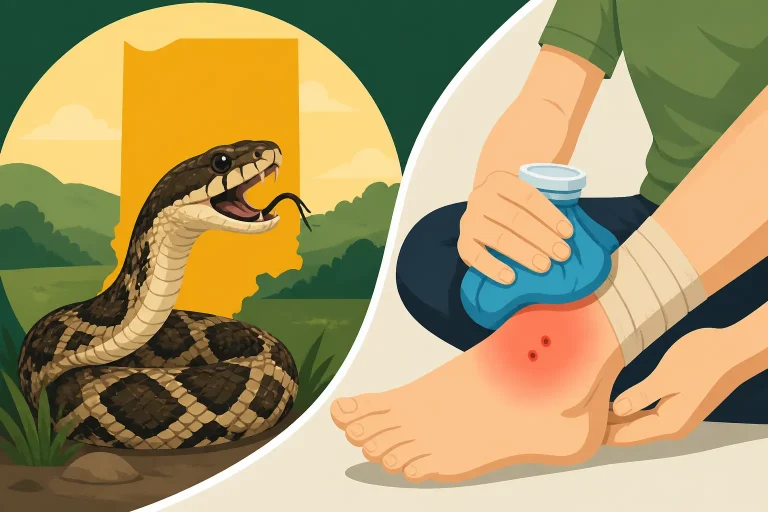
A bite from a snake that may be venomous needs urgent medical attention. Do not wait to see whether symptoms develop or try to settle the species identification before seeking help. If someone has been bitten and the snake may be venomous, call 911 or Poison Help at 1-800-222-1222.
Do not attempt to catch or kill the snake. Trying to handle it can lead to another bite, and capturing it is not necessary to ask for medical care. If you can recall visible details without returning to the snake or delaying help, share them with medical professionals. A photo taken from a safe distance may be useful only if one is already available; do not go back to get one.
For a possible bite, focus on getting professional help rather than trying a home treatment or relying on online identification. If the person is in a public location, alert someone nearby who can help coordinate emergency assistance while keeping others away from the snake. Do not let curiosity or uncertainty delay the call.
A bite may be hard to assess at first, and a person may not be sure which snake was involved. Treat the possibility of a venomous bite seriously and explain the situation to emergency responders. The article Snakebite in Indiana: The First Steps While Help Is on the Way provides additional bite-related guidance.
Frequently Asked Questions
Are copperheads found throughout Indiana?
No. The Indiana Department of Natural Resources, Division of State Parks, places them in the southern half of the state, with its information also noting southern and west-central Indiana. That range does not mean every site in those areas has copperheads.
Does a banded snake in southern Indiana mean it is a copperhead?
No. Some nonvenomous snakes have bands or other markings that can be confusing. Compare the complete pattern, coloring, body shape, and habitat with reliable species descriptions, and keep your distance if you are not sure.
Should I try to move a copperhead away from my house?
Don’t try to handle or move a snake you cannot confidently identify. Keep people and pets away, and contact a qualified professional or the wildlife agency for advice if the snake needs attention.
Is a copperhead’s head shape enough to identify it?
No. Head shape is only one possible clue, and a quick view can be misleading. Use several features together, and do not approach to get a closer look.
Sources
- Indiana Department of Natural Resources, Division of State Parks — Fish and Wildlife: Snakes (checked November 20, 2026)
- Indiana Department of Natural Resources, Division of State Parks (checked November 20, 2026)
- Indiana Department of Natural Resources — Common Snakes of Indiana State Parks (checked November 20, 2026)
- Indiana Department of Natural Resources, Division of State Parks — Fish and Wildlife: Amphibians and Reptiles FAQs (checked November 20, 2026)
Disclaimer
This article is for general informational purposes only and does not constitute professional advice. Laws, prices and regulations vary by location and change over time. Consult a qualified professional for guidance on your specific situation. Indiana Critter Guide is not a government agency or pest control company and is not affiliated with any government agency.